
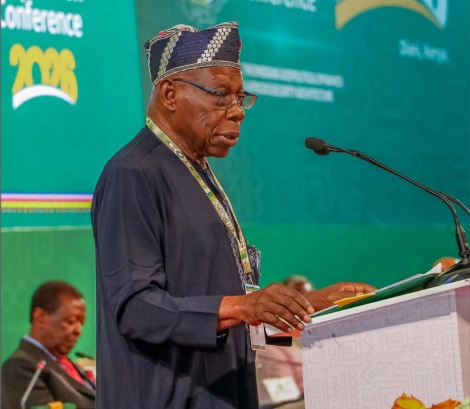
Facing a new wave of instability, Africa’s intelligence chiefs gathered in Kenya on Thursday, April 9, 2026 to hear a stark message from Olusegun Obasanjo. The former Nigerian president, drawing on decades of experience mediating conflicts from Liberia to Zimbabwe, challenged them to prioritise courageous honesty and good governance, presenting his “Obasanjo 55+20 Leadership Framework” as a guide for building lasting peace. ROLAND OGBONNAYA reports
The salt-laced breeze off the Indian Ocean carried the scent of frangipani as Olusegun Obasanjo, a figure synonymous with African resilience and peacemaking, addressed a room full of the continent’s most powerful intelligence chiefs. Approaching his ninetieth year, the former Nigerian president didn’t offer a conventional diplomatic address on Thursday, 9 April 2026. Instead, he delivered a bracingly honest, almost confessional account of six decades spent navigating Africa’s turbulent landscape of conflict – a lifetime spent attempting to stitch together fractured nations.
The Mashariki Cooperation Conference, hosted by Kenya’s National Intelligence Services in the coastal town of Diani, brought together over 80 intelligence chiefs from across Africa and the Caribbean. But Obasanjo’s speech transcended the usual forum for security elites. It was a sweeping narrative, punctuated by personal anecdotes and hard-won wisdom gleaned from the battlefields of Congo, the negotiating tables of Burundi, and the fraught political arenas of Zimbabwe and beyond.
“Diplomacy,” he recalled, referencing his time as head of state in the late 1970s, “must occasionally be backed by economic consequence to be taken seriously.” He spoke of nationalising British Petroleum’s Nigerian assets as a direct response to the company’s continued trade with apartheid South Africa, a move that demonstrated a willingness to wield economic leverage for moral and political ends.
However, the core of his address revolved around the conflicts that defined his post-presidency – a period dedicated to tirelessly mediating and intervening in some of the continent’s most brutal civil wars. He spoke candidly about the complexities of ECOWAS’s first major military intervention in Liberia, ECOMOG, acknowledging its success in preventing state collapse but cautioning that “military intervention without a credible political process is at best a pause in fighting.”
Sierra Leone, he recounted, was a particularly painful lesson. He lamented the failure of mediators to accurately identify the Revolutionary United Front (RUF) as a criminal enterprise masquerading as a revolutionary movement, a misjudgment that contributed to the horrific atrocities committed, including the amputation of children’s hands. “Thousands of lives were paid for that failure,” he stated, his voice heavy with regret.
Burundi, where he succeeded the late Julius Nyerere in mediation efforts, taught him a crucial, often overlooked truth: “a peace agreement is not a peace. It is the beginning of a political process.” He stressed the importance of sustained engagement and institution-building long after the signing of any accord.
Obasanjo didn’t shy away from difficult truths, even when they meant challenging fellow African leaders. He openly discussed his public condemnation of Robert Mugabe’s disastrous policies in Zimbabwe, a stance that strained relationships across the continent. “That position cost me some friendships on the continent,” he admitted, “I have no regrets about it.” His unwavering commitment to principle, even in the face of political fallout, underscored a central theme of his address: the paramount importance of courageous honesty in leadership.
But the most striking element of Obasanjo’s presentation was the unveiling of his “Obasanjo 55+20 Leadership Framework” – a meticulously crafted set of 55 attributes and 20 values he believes are essential for leaders who aspire to build lasting institutions. These weren’t abstract ideals, but rather lessons distilled from decades of observing both the successes and failures of African leadership.
Among the attributes, “courageous honesty” stood out – “the willingness to tell parties to a conflict, and indeed to tell one’s own government, what they need to hear rather than what they wish to hear.” The values, he explained, were equally critical, with “patriotism” defined not as blind allegiance, but as “the understanding that sustainable peace requires not the victory of one party over another but the construction of arrangements in which all significant groups can see their legitimate interests protected.”
He presented the framework not as an academic exercise, but as a mirror held up to the assembled intelligence and security chiefs. “The heads of intelligence and security services assembled in this hall are among the most powerful individuals in their respective nations,” he declared. “The temptations that come with such power are proportionally exceptional. What keeps those temptations in check, ultimately, is the character of the leader.”
Dr. Amina Mohammed, Deputy Secretary-General of the United Nations, who was present at the conference, commented on the impact of Obasanjo’s address. “He spoke with a moral authority that is rare in international diplomacy,” she said. “He didn’t offer easy answers, but he forced us to confront uncomfortable truths about the role of leadership in perpetuating – or preventing – conflict.”
Obasanjo’s voice, weathered by experience, carried the weight of someone who has truly “sat across tables from warlords and statesmen.” He spoke of the “particular exhaustion” of a peace process that collapses after years of tireless effort, and the “particular satisfaction, rare but real” of witnessing communities slowly rebuild their lives. “I am still learning from all of it,” he confessed, demonstrating a humility that belied his immense experience.
As he nears his tenth decade, Obasanjo’s message was a potent blend of warning and testament. He insisted that Africa’s conflicts are not inevitable, nor are they a result of some inherent deficiency in the continent’s capacity for peace. Instead, he argued, they are the direct consequence of specific failures in leadership and governance, exacerbated by the willingness of external actors to exploit those vulnerabilities.
“The 55 attributes and 20 values did not emerge from a library,” he emphasized. “They emerged from nine decades of life on this continent – from the battlefields of the Congo and the Nigerian civil war, from the peace tables of Pretoria, Arusha, Addis Ababa, Lusaka and Abuja, from a prison cell in Jos and Yola where I had nothing but time and conviction, and from the experience of handing over power peacefully on 29 May 2007.” The reference to his imprisonment, a period of reflection during the Abacha regime, underscored the personal cost of his commitment to democratic principles.
Professor Adebayo Williams, a leading political analyst at the University of Ibadan, Nigeria, believes Obasanjo’s framework is particularly relevant in the current geopolitical climate. “Africa is facing a new wave of instability, fuelled by climate change, resource scarcity, and the rise of extremist groups,” he explained. “Obasanjo’s emphasis on ethical leadership and good governance is more crucial than ever. We need leaders who are willing to prioritize the long-term interests of their people over shortterm political gains.”
Obasanjo concluded his address with a direct exhortation to the assembled intelligence chiefs. “Serve your nations. Protect your people. Share your knowledge across borders. Expose the financiers, arms suppliers, and external manipulators who profit from African instability. Build the continental intelligence community Africa needs.”
Then, a final, unsettling coda that lingered in the air. “Is Iran a true, genuine and serious threat to the US? I leave that to you. Misinterpretation and misapplication of intelligence are always disastrous. We saw it in Iraq.” The pointed reference to the intelligence failures that led to the Iraq War served as a stark reminder of the potential consequences of flawed analysis and political bias.
As the conference adjourned and the Indian Ocean continued its rhythmic lapping against the Kenyan coastline, the weight of Obasanjo’s words settled upon the attendees. Nearly nine decades of African history had spoken, offering not just a retrospective analysis of past conflicts, but a challenge to the next generation of leaders to be wiser, more courageous, and more committed to building a truly peaceful and prosperous continent. The question, as Obasanjo left it hanging, was whether they would heed the call.