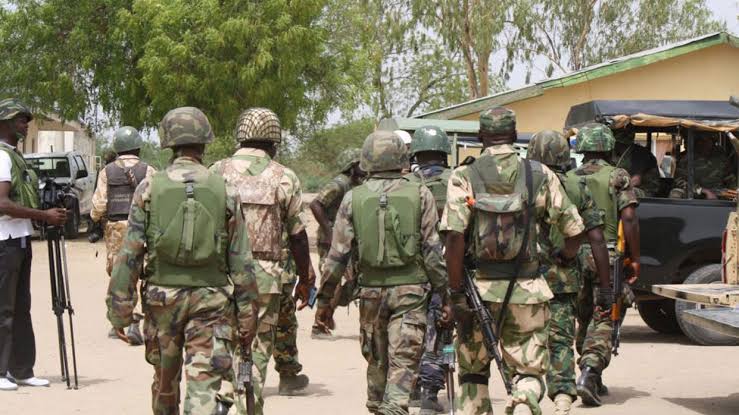
By mid-2025, Nigeria’s security situation had drifted far from the early wins of President Bola Tinubu’s administration. What unfolded instead was a year defined by jihadists’ infiltration from the Sahel, the re-emergence of mass abductions, and a controversial international episode involving US President Donald Trump that exposed the fragility of Nigeria’s counter-terrorism diplomacy.
Taken together, these developments tanked the gains the Bola Tinubu government had achieved since it came into power in 2023. The developments also show that insecurity remains Nigeria’s number one governance challenge.
Jihadists without borders
Perhaps the most alarming security trend of 2025 was the growing sense that Nigeria’s northern frontiers were more porous and could not be protected from the spillover of violence in the Sahel, where jihadists in the folds of Islamic States and al-Qaeda are expanding their horizons.
The arrests of key Ansaru figures signalled concerns about al-Qaeda–aligned networks with transnational reach. Unlike the other jihadi groups—Boko Haram and Islamic State West Africa Province (ISWAP)—largely contained in the North-east and the Lake Chad region, Ansaru’s historical footprint spans north-central and north-western Nigeria, with deep links to cross-border logistics, arms trafficking and illicit trade.
While Ansaru struggles to fill the leadership gap created by the arrests, the group’s Sahelian allies fighting under the banner of al-Qaeda-linked Jama’at Nusrat al-Islam wal-Muslimin (JNIM) announced their presence in Nigeria, further blurring Nigeria’s counterterrorism war.
At the same time, security agencies intensified monitoring of Lakurawa fighters and the Sadiku-led Boko Haram faction around Nigeria’s borders with Benin and Niger.
The implication was clear: Nigeria’s security challenge in 2025 was no longer purely domestic and was increasingly shaped by regional jihadi terror campaigns.
President Tinubu acknowledged the transnational nature of Nigeria’s security crisis in his New Year message and said his administration would work with partners to address the threat. “In 2026, our security and intelligence agencies will deepen cooperation with regional and global partners to eliminate all threats to national security,” he said.
The cost of command losses
This security crisis was compounded by the killing of Musa Uba, a brigadier general, one of the most senior military officers lost in combat in recent years.
Beyond the immediate operational shock, the incident carried symbolic weight. Analysts believe that high-ranking officer casualties erode troop morale.
Mr Uba’s death raised difficult questions about intelligence penetration, battlefield exposure, and the adaptability of armed groups that Nigeria continues to fight.
Still in the military, President Bola Tinubu sacked some military chiefs. Only the Chief of Army Staff, Olufemi Oluyede, was retained and promoted to the position of Chief of Defence Staff (CDS).
However, about a month later, the former CDS, Christopher Musa, was appointed the defence minister, following the resignation of Mohammed Abubakar.
Security gains
Despite the challenges, 2025 was not without security gains for the Tinubu administration. These included the killing and arrests of several terrorists in the North.
The Defence Headquarters, in its 2025 report, said 1,323 suspects were arrested while 1,616 others surrendered in the North-east. Military spokesperson Micheal Onoja told journalists in Abuja on Wednesday that 498 kidnapped victims were rescued as troops recovered arms, vehicles and equipment, alongside N32 million in cash during various operations.
This, he said, was in addition to the destruction of terrorist camps in the region.
In the North-West, Mr Onoja said troops under Operation Fansan Yamma killed scores of terrorists, arrested 669 suspects, and rescued 966 abducted persons. He added that precision airstrikes on ISIS enclaves in the Bauni Forest, Sokoto State, destroyed key terrorist assembly points without recording civilian casualties.
In the North-central region, the defence spokesperson said troops of Operation Enduring Peace killed many terrorists, arrested 822 suspects, rescued 217 abducted victims, and recovered sophisticated weapons.
He added that troops of Operation Whirl Stroke also killed many extremists, arrested 459 suspects, and rescued 538 hostages, alongside the recovery of additional arms and ammunition.
Killings that defined the year
While arrests and battlefield gains defined the government’s successes, mass killings defined the year’s failures.
In April 2025, terrorists attacked communities in Benue State, killing over 100 residents in coordinated assaults that overwhelmed local defences and security response.
Similar attacks were recorded in parts of Plateau, Zamfara, and Kaduna states, often framed along ethnic or religious lines.
In January 2025, suspected ISWAP fighters stormed Dumba, a village on the shores of Lake Chad, killing at least 40 farmers.
Trump’s ‘evangelism’
Nigeria’s security narrative took an unexpected international turn following a dramatic episode involving President Trump, whose public remarks and engagements with American evangelical constituencies framed Nigeria’s violence primarily through a Christian persecution lens.
Calling Nigeria a “now-disgraced” country, Mr Trump threatened military action in Nigeria if the West African country failed to stop what he described as “Christian genocide.”
However, the Nigerian government disputed his claim, explaining that Nigerians of all backgrounds and faiths are being targeted by armed groups.
While not immediately accompanied by direct military action, the episode unsettled Nigerian officials. It risked oversimplifying Nigeria’s complex security crises into a single religious conflict, potentially inflaming domestic tensions.
For the Nigerian government, the concern was not just optics. It was the danger that Nigeria’s security challenges could be externally instrumentalised for ideological messaging abroad, complicating cooperation and inflaming internal fault lines.
What followed Mr Trump’s outburst was a series of diplomatic actions by both parties. Then, there was a resurgence of mass abductions that seemed tactical and strategic on the terrorists’ side.
US airstrikes and civilian Impact
Weeks after threatening military action in Nigeria, the United States launched airstrikes that targeted “Islamic State–affiliated terrorists” in Sokoto. The operation was publicly confirmed by President Trump and acknowledged by Nigerian authorities.
The Nigerian government said President Bola Tinubu approved the strikes and that Nigerian security agencies also provided intelligence used by the US for the strikes.
Mr Trump described the targets of the airstrikes as terrorists who have continued to kill Christians in Nigeria.
While official statements framed the strikes as precise and coordinated with Nigerian forces, reports emerged of munitions debris landing in civilian areas, including Jabo, a rural community in Sokoto. The incident led to panic.
Resurgence of mass abductions
If there was one security issue that most visibly undercut the Tinubu government’s achievements in 2025, it was the resurgence of mass abductions, particularly school kidnappings and attacks on worship centres.
After years of policy declarations and military deployments, armed groups once again demonstrated their ability to seize dozens of civilians.
In November alone, there were three mass abductions: two at schools in Kebbi and Niger, and the other at a Church in Kwara State.
The political damage was significant. Such abductions are not just crimes; they are symbols of state failure, instantly undoing claims of improved security. Most of the kidnapped victims were later freed, although the government declined to state the conditions that led to their release, with President Tinubu saying, “The end justifies the means.”
Policy Responses and Structural Reforms
In response to mounting insecurity, the Tinubu administration pushed several policy and legislative measures in 2025. Some of these include renewed momentum on the state police bill, aimed at decentralising security and empowering sub-national governments.
Among other measures, the government also deployed newly trained 7,000 forest guards to reclaim ungoverned forests used by bandits and insurgents. From the North-east to the North-central, terrorists have continued to use forest reserves as hideouts.
While these initiatives signalled intent, PREMIUM TIMES will monitor their implementation in 2026
A year that flattened achievements
By the close of 2025, Nigeria’s security landscape told a sobering story. The marginal gains the Tinubu administration cited—arrests, killings and dislodging of terrorists—were overshadowed by trends it could not easily reverse.
Rather than a year of consolidation, 2025 became a reminder that security gains in Nigeria are fragile, reversible, and easily eclipsed by a single mass kidnapping or killings.
In that sense, the year, arguably, did not merely challenge the government’s wins—it flattened them.