
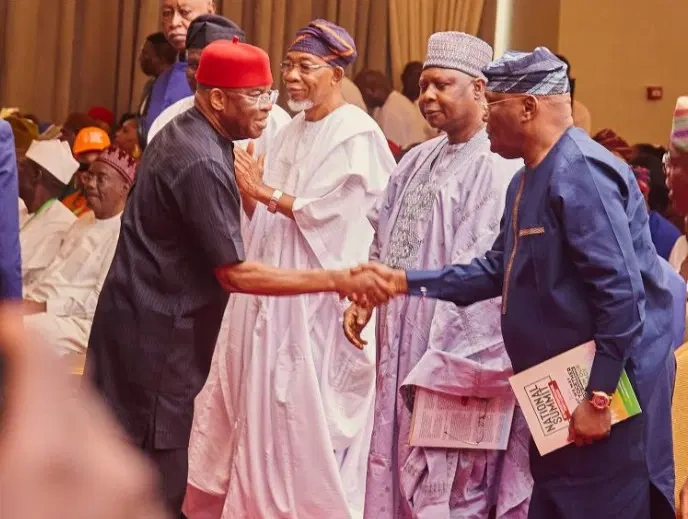
A proposed plan by leading opposition figures to field a joint presidential candidate against Bola Tinubu in the 2027 election has stirred sharp reactions across Nigeria’s political landscape.
The move followed a high-level meeting in Ibadan hosted by Seyi Makinde, where prominent opposition leaders—including Atiku Abubakar, Peter Obi, Rotimi Amaechi, Rauf Aregbesola, David Mark, and Tanimu Turaki—agreed in principle to unite behind a single candidate.
The coalition, involving factions of the African Democratic Congress (ADC) and the Peoples Democratic Party (PDP), is aimed at mounting a stronger challenge to the ruling All Progressives Congress (APC).
However, the initiative has triggered mixed reactions, with critics questioning its feasibility and sincerity.
The APC, through its spokesman Felix Morka, dismissed the coalition as a “confused gathering” and condemned remarks by Governor Makinde referencing the historically violent Operation Wetie, warning that such rhetoric could incite unrest.
Senior government officials, including Nyesom Wike and Festus Keyamo, also rejected the opposition’s plan, describing it as “dead on arrival” and lacking organisational clarity.
Keyamo, in particular, questioned how a merger would work in practice, asking how parties would reconcile competing candidates across different electoral levels.
Meanwhile, Omoyele Sowore, leader of the African Action Congress (AAC), distanced himself from the summit, arguing that those behind the coalition lacked credibility as true opposition figures.
In contrast, the New Nigeria Peoples Party (NNPP), through its spokesman Ladipo Johnson, described the move as a “historic realignment,” expressing optimism that a united front could challenge the APC effectively.
Socio-political group Afenifere supported the idea in principle but stressed that any coalition must be driven by clear ideological direction and pro-people policies, not just the ambition to seize power.
Political elder Akin Osuntokun also welcomed the initiative, noting it could help prevent Nigeria from drifting toward a one-party system.
However, divisions persist within the opposition itself. A faction of the ADC, led by Kingsley Ogga, rejected the Ibadan meeting, insisting the party must first resolve internal disputes. Similarly, the Social Democratic Party (SDP) said it was not part of the coalition and criticised the process as exclusionary.
Adding another perspective, Chekwas Okorie of the All Progressives Grand Alliance (APGA) described the plan as a strategic counter to APC dominance but cautioned that its success would depend on sincerity, unity, and implementation.
With multiple factions, competing ambitions, and unresolved internal conflicts, the opposition’s push for a unified presidential candidate remains uncertain, even as it signals an early realignment ahead of the 2027 general election.