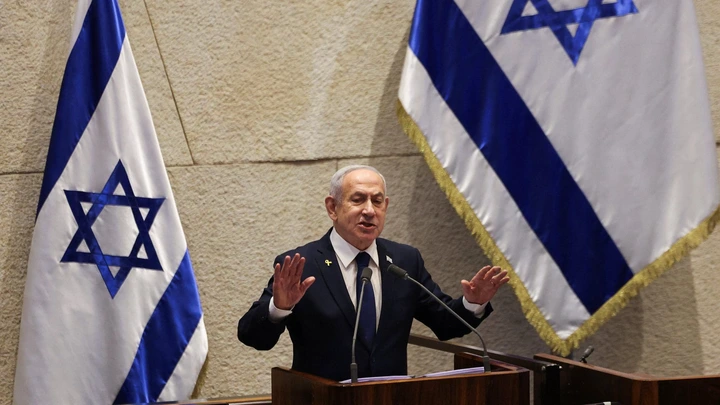
Israeli Prime Minister Benjamin Netanyahu has announced plans to support Christian communities facing persecution in Nigeria and other parts of Africa and the Middle East.
Netanyahu told Evangelical Christian leaders Wednesday in Palm Beach, Florida that Israel is joining an emerging alliance of countries that support Christian communities around the world, according to The Times of Israel. The announcement came during meetings with evangelical community leaders and United States President Donald Trump.
Netanyahu described Israel as the only country capable of protecting Christians worldwide during the Friday meeting in Florida, Business Day reported. He told the audience that Christian Zionism had facilitated the rise and success of Jewish Zionism, establishing what he called an enormous partnership that had endured through thick and thin.
The Israeli leader stated his government recently fought what he described as a seven front war and emerged largely victorious. He identified an eighth front centered on influencing public opinion, particularly among young people, which he called a battle for hearts and minds.
Netanyahu identified radical Shiite Islam and radical Sunni Islam as the main forces waging what he described as a global battle against Judeo Christian tradition. He pointed to Iran and the Muslim Brotherhood as leading opposing axes, stating they go to Europe, the United States, Africa and Nigeria.
The prime minister said Israel is conscious of the fact that Christians are being persecuted across the Middle East, in Syria, in Lebanon, in Nigeria, in Turkey and beyond. He asserted that one country protects the Christian community, enables it to grow, defends it and makes sure it thrives, claiming that country is Israel.
Netanyahu announced Israel was joining efforts to establish what he described as a coalition similar to a United Nations framework to support beleaguered Christian communities worldwide who deserve help. He said Israel is capable of providing support in Africa with intel and in the Middle East with various means he would not itemize.
The Israeli leader described the initiative as reciprocal support. Just as you are helping us, we want to help back and we’re capable of doing this, he told evangelical leaders. He stated protecting Christian communities is a main part of Israel’s agenda and would continue with greater force and greater might in 2026.
Netanyahu’s remarks came a day after his meeting with Trump, who had announced air strikes in Nigeria on Christmas Day in fulfillment of his military intervention threat to stop alleged Christian persecution in the country, according to TheCable. On the same day as the strikes, Netanyahu said attacks on Christians in Nigeria must come to an end.
Israel is the only country to publicly side with the United States on its claim of Christian persecution in Nigeria, TheCable reported. The Nigerian government has rejected claims of systematic persecution of Christians, stating that insecurity affects citizens of all faiths.
Netanyahu was in the United States to discuss situations in Gaza and the West Bank as well as simmering conflicts with Iran and the Hezbollah group in Lebanon. He attended a New Year’s Eve party hosted by Trump at his Mar a Lago resort before departing for Israel on Thursday afternoon United States time.
The announcement sparked reactions in Nigeria, where religious violence has claimed lives across different communities. Security analysts have noted that attacks by armed groups in Nigeria often target both Christian and Muslim communities based on geographic and economic factors rather than purely religious motivations.
Turkey, which Netanyahu listed among countries persecuting Christians, is home to approximately 100,000 Christians. Some Turkish Christians have stated their community struggles against inequality and exclusion under President Recep Tayyip Erdogan’s rule, according to The Times of Israel.
Netanyahu did not provide specific details about which countries would participate in the proposed coalition or what operational mechanisms the alliance would employ to protect Christian communities. He also did not clarify whether the initiative had received commitments from other governments.