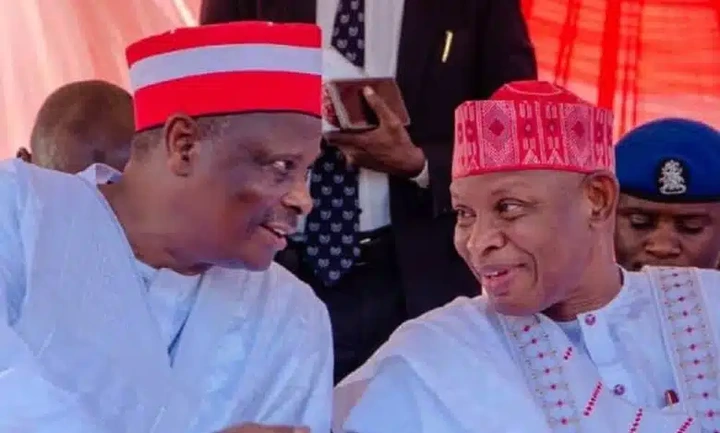
The political alliance between the leader of the New Nigeria People’s Party (NNPP), Rabiu Musa Kwankwaso, and Kano State Governor, Abba Kabir Yusuf, has broken down.
Sources who spoke with Sunday Sun say the longstanding relationship, which lasted about four decades and produced them as governors at different times, has been strained by divergent political interests.
According to political observers, the key issue dividing the two leaders is that while Kwankwaso plans to remain in the NNPP to pursue his presidential ambition or reconnect with other opposition forces, Governor Yusuf will soon defect to the ruling All Progressives Congress (APC) to seek a second term.
A source told Sunday Sun that the official defection could occur sooner than expected, giving the governor time to engage in the forthcoming APC congress fully.
Governor Yusuf has already been meeting with APC leaders in Kano, including a Wednesday discussion with APC State Chairman, Abdullahi Abbas, just before the chairman travelled abroad.
Earlier in the week, the governor also held a midnight meeting with former Kano State House of Assembly Speaker, Kabiru Rirum, and later crossed paths with former APC National Chairman, Abdullahi Umar Ganduje, at the Mallam Aminu Kano International Airport.
The holiday week saw an open test of influence between the opposing camps. While some NNPP members were prepared to renounce their party badges for the APC, others resisted, reluctant to abandon Kwankwaso.
Sources said many party members were indebted to Kwankwaso for their political ascendance and recalled past episodes where defectors lost out while Kwankwaso’s loyalists thrived.
“Previous attempts of defection against Kwankwaso had somehow wound up in his favour against those who disengaged from him. The impact of this public truth has, so far, made the journey to the APC for defectors a little bit difficult,” a source said.
As of now, several notable NNPP figures are said to be sticking with Kwankwaso, including Deputy Governor Abdulsalam Aminu Gwarzo, State Chairman Hamisu Dungurawa, and the governor’s political adviser. A few state lawmakers have also declared loyalty to Kwankwaso.
Among local government chairmen, some are reportedly inclined to stay with the NNPP but fear fallout if they fail to align with Governor Yusuf’s political direction.
News of the impending defection has hit Kano like a tsunami, with political positions and loyalties thrown into disarray. One casualty has been State Party Chairman Hashimu Dunguruwa. Shortly after defection rumours went public, the NNPP executive in his Gargari Ward announced his suspension and a faction appointed Abdullahi Zubairu Abiya as his replacement.
However, this move was later debunked by the NNPP National Working Committee, which described the suspension as “misplaced, undemocratic, null and void,” in a statement signed by National Publicity Secretary Bamofin Ladipo.
There was also an unconfirmed report that Mustapha Kwankwaso, son of Rabiu Musa Kwankwaso, resigned from the Kano State Executive Council.
Insiders point to several factors behind the rift, including alleged interference by Kwankwaso and pressures from intermediaries who sought to widen the divide. They say the core issue is that both men’s interests no longer align.
According to one source, “This is the crux of the matter. The governor goes to APC, gets the ticket and easily wins in 2027. Kwankwaso goes with him to the APC, but what does he get in 2027? Not the vice‑presidential slot and maybe not even a ministerial slot. That is why he has been reluctant to defect to the APC with an empty promise.”
The source added that, despite the tension, there is not necessarily personal malice between the two leaders, noting that they are related by family ties and that much of the heat is being driven by loyalists.
The evolving strife has unsettled the political class in Kano. Aides fear job losses, while supporters of the governor are gearing up for political battles, viewing the dispute as an opportunity.
Opposition parties, particularly the Peoples Democratic Party (PDP), are also said to be monitoring the fallout for political leverage.