
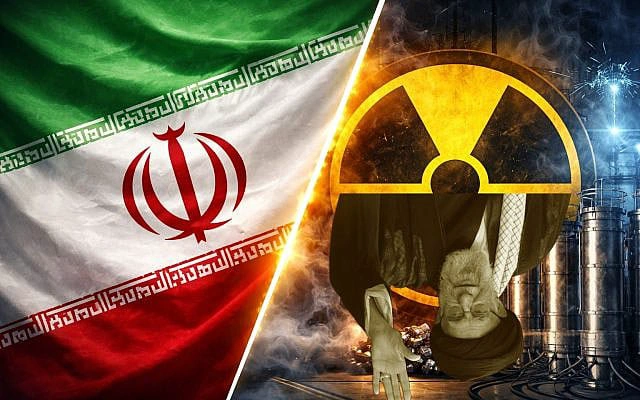
For two decades, one document stood between Iran and the bomb — at least in diplomatic terms. Ayatollah Khamenei’s fatwa against nuclear weapons was cited in international negotiations, referenced by Western analysts, and treated by some governments as genuine evidence that Iran would not pursue nuclear arms. On February 28, 2026, Khamenei was killed in a joint U.S.-Israeli strike. The fatwa died with him.
And 440 kilograms of uranium enriched to 60 percent purity — enough, if further enriched, for ten nuclear weapons — sit in an underground tunnel complex in Isfahan, beyond the reach of international inspectors.
The question is no longer whether Iran has the technical capacity to build a nuclear weapon. The question is whether anything still prevents it from doing so.
The Fatwa: Diplomatic Shield, Not Religious Conviction
For years, Iran’s nuclear fatwa served as a centerpiece of its diplomatic defense. Iranian officials cited it at the United Nations, in negotiations with the P5+1, and in public statements intended to reassure the international community. Some Western analysts accepted it as a meaningful constraint.
But the Washington Institute for Near East Policy documented that fatwas in the Islamic Republic are governed by the principle of maslahat — regime expediency. They can be issued, modified, or reversed when strategic circumstances require it. The Atlantic Council went further, noting that Khamenei himself described Iran’s entry into the JCPOA as taqiyya — religiously sanctioned deception. If the agreement that supposedly operationalized the fatwa was itself an act of deception, the fatwa was never a permanent theological prohibition. It was a tool — deployed when useful, retractable when not.
In February 2025, according to The Telegraph via the Jerusalem Post, senior IRGC commanders pressured Khamenei to rescind the fatwa, arguing that Iran faced existential threats from the West. One official reportedly stated: “We have never been this vulnerable, and it may be our last chance to obtain one before it’s too late.” Khamenei resisted. One month later, he was dead. And with his death, as IranWire’s legal analysis detailed, the fatwa’s binding authority effectively ended — in Shia jurisprudence, a fatwa is tied to the life of the issuing marja, and since Khamenei never codified his ruling as a governmental decree (hukm-e hukumati), no branch of the Islamic Republic is any longer bound by it. Mojtaba Khamenei, chosen as supreme leader on the explicit criterion that he should “be hated by the enemy,” has neither reaffirmed nor rejected his father’s fatwa.
The diplomatic shield is gone.
What Remains: 440 Kilograms in the Dark
As of the IAEA’s last verified inspection on June 13, 2025 — the day Israeli strikes began — Iran possessed 440.9 kilograms of uranium enriched to 60 percent. This is the largest stockpile of highly enriched uranium held by any non-nuclear-weapon state in history.
The majority — over 200 kilograms — was stored in an underground tunnel complex at Isfahan. IAEA Director General Rafael Grossi confirmed in March 2026 that the material is “probably still there.” Satellite imagery shows the tunnel complex sustained minimal damage from the June 2025 strikes, with regular vehicular activity continuing around its entrance. Additional quantities were stored at Natanz and possibly Fordow.
Since June 13, 2025, the IAEA has had no access to any of Iran’s four declared enrichment facilities. It cannot verify the size, location, or status of the stockpile. It cannot confirm whether enrichment has resumed. And it cannot confirm the status of a fourth enrichment facility — the Isfahan Fuel Enrichment Plant (IFEP) — that Iran declared just before the strikes but that the IAEA has never visited and whose precise location remains unknown.
In its March 2026 statement, the E3 (Britain, France, Germany) warned that the IAEA “reports increasing risk of diversion” and noted that the agency “clearly does not discount the possibility that this enrichment plant was already operational.”
Nine months without international monitoring. A stockpile sufficient for ten weapons. A declared enrichment facility that no inspector has ever seen. And a regime that, according to U.S. envoy Steve Witkoff, openly boasted during negotiations about having enough enriched uranium for eleven bombs.