
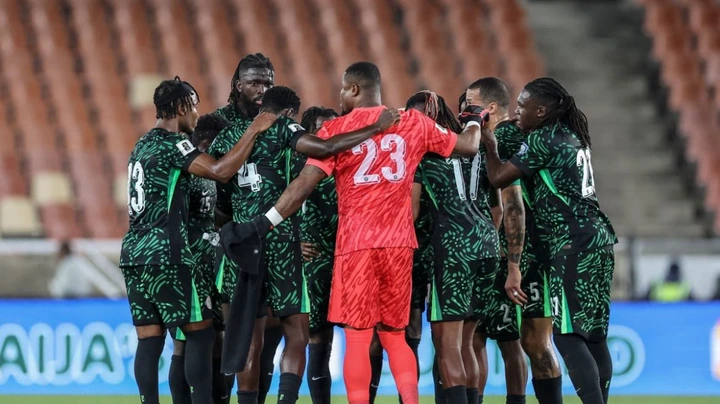
The only time Nigeria and Morocco senior national teams have clashed in Morocco’s administrative capital, Rabat, Nigeria dug their feet into the ground to earn a scoreless draw, win the ensuing penalty shootout and secure qualification to the 14th Africa Cup of Nations finals in Cote d’Ivoire.
The date was Saturday, 28th August 1983. Two weeks earlier, in Benin City, both teams had ended the first leg match 0-0.
The return leg took place in Rabat, with Coach Adegboye Onigbinde making a number of changes to the squad that featured in Benin City.
Goalkeeper Peter Rufai came in for Wilfred Agbonavbare, and Kingsley Paul, Amos Edoseghe, Anthony Edward, Wole Odegbami and Sunday Daniel came in for Charles Osuji, Henry Nwosu, Rafiu Yusuf, Dehinde Akinlotan and Tarila Okorowanta.
Coach José ‘Mehdi’ Faria, the Brazilian minder of the Atlas Lions, stuck to his regular group, including goalkeeper Badou Ezzaki, Mustapha El Haddaoui, Abdelaziz Bouderbala, Mohamed Timoumi, Abdelmajid Lamriss, Mustapha El Biyaz, Noureddine Bouyahyaoui and Khaled Labied. A closely-fought battle ended 0-0, necessitating a penalty shootout.
Nigeria won 4-3 to qualify for the AFCON finals in Cote d’Ivoire, where she emerged runner-up.
As the Super Eagles file out onto the turf of the Prince Moulay Abdellah Stadium on Wednesday, they will remember they have never lost a match to the Lions in Rabat.
Two goals against the Atlas Lions on Wednesday will put Victor James Osimhen at par with Nigeria’s revered ‘goalsfather’ Rashidi Yekini in the number of goals scored for the Nigeria national team at the senior level.
The Galatasaray of Turkey forward has 35 goals in 51 matches, while ‘Goalsfather’ netted 37 times in his 58 matches for the country.
At just 27 years of age and at the peak of his powers, Osimhen is easily tipped to score many more goals for Nigeria, effectively breaking the record set by the gangling poacher of blessed memory.
At the time Yekini passed on 4th May 2012, Osimhen’s name was yet to come into reckoning at the international level.
He rang his bell to the universal audience in 2015, when he emerged top scorer (with 10 goals) and the second most valuable player of the FIFA U17 World Cup tournament that Nigeria won in Chile that year.
History beckons on the former SSC Napoli forward on Wednesday night, as the 90-minute battle, for which he will have Alex Iwobi, Akor Adams and Ademola Lookman providing valuable support, offers him the opportunity to equal the great man’s tally.
Iwobi, who has been extraordinary at this AFCON, is set to win his 96th cap for the country, taking him closer to the century mark of former captain Joseph Yobo and former goalkeeper Vincent Enyeama, who garnered 101. Ahmed Musa remains the man with the record at 111 caps.
Franco-Malian manager, Éric Sékou Chelle, will walk inside the Prince Moulay Abdellah Stadium with springs in his steps, having never lost a competitive match in regulation time since taking over Nigeria’s ‘A’ squad 12 months ago.
Chelle’s tally is a tidy 11 wins in 17 matches of the Super Eagles, with five draws, and losing once in regulation time to the Pharaohs of Egypt when Nigeria put out an understrength squad in a friendly in Cairo on 16 December.
Nigeria’s U17 women’s team, the Flamingos, will begin their quest for qualification to the 2026 FIFA U17 Women’s World Cup finals when they enter the African qualifiers at the second round stage. The Flamingos are set to face the winner of the preliminary round tie between the Niger Republic and Guinea.
The first leg of the second round is scheduled to take place between 22nd – 24th May, with the return leg billed for 29th – 31st May. The winner on aggregate over the two legs will advance to the third and final qualifying round. In the third round, the first leg matches will be played between 3rd – 5th July 3, while the second legs are fixed for 10th – 12th July.
Successful teams at the end of the qualifiers will secure their places at the 2026 FIFA U17 Women’s World Cup, which will be hosted by Morocco in October. Nigeria remain one of Africa’s most consistent performers at the U17 level and will be aiming to return strongly to the global stage after their last outing ended in disappointment.
The Flamingos were eliminated in the Round of 16 following a 4–0 defeat to Italy – a result that brought their campaign to an abrupt halt in the tournament. That exit has placed added focus on the upcoming qualifiers, as the Flamingos look to rebuild momentum and reassert their status as one of the continent’s traditional powerhouses in women’s youth football.