
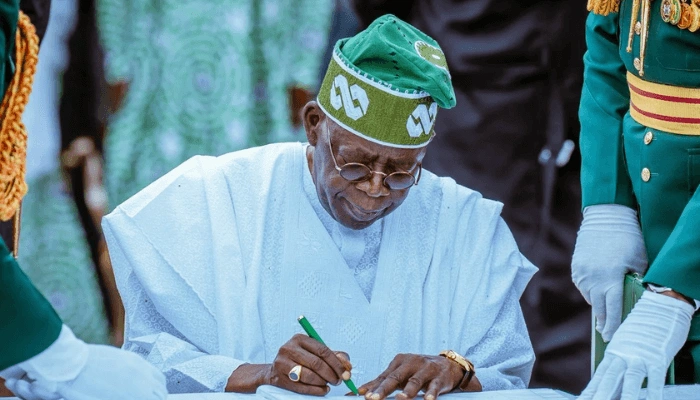
In a significant move that aims to reshape Nigeria’s oil and gas revenue management, President Bola Tinubu has signed an executive order that redirects oil and gas revenues directly to the Federation Account, bypassing the Nigerian National Petroleum Corporation (NNPC). This decision is rooted in a desire to curb wasteful spending, eliminate duplicative structures, and ensure that Nigeria’s oil wealth benefits the nation more effectively.
The President’s Executive Order, issued in February 2026, is intended to restore the constitutional revenue entitlements of the Federal, State, and Local Governments, which have been undermined by the provisions of the Petroleum Industry Act (PIA) of 2021. This article delves into the implications of this decision for Nigeria’s fiscal landscape, exploring the potential impact on governance, investors, and various stakeholders in the oil sector.

The Drive for Fiscal Transparency and Efficiency
One of the core objectives behind President Tinubu’s Executive Order is to restore fiscal efficiency and transparency in Nigeria’s oil and gas sector. Under the current framework established by the Petroleum Industry Act (PIA), a substantial portion of Nigeria’s oil revenues has been siphoned off through a series of deductions. The NNPC Limited, for instance, retains 30% of the Federation’s oil revenues as a management fee on profit oil and gas derived from production sharing contracts. This retention is in addition to another 30% earmarked for speculative exploration, even as government resources are urgently needed to fund national priorities such as security, education, and healthcare. The President’s order eliminates these unjustifiable deductions, directing the revenue directly into the Federation Account for the benefit of all tiers of government. This shift is expected to boost revenue inflows and ensure that Nigeria’s oil wealth is more efficiently allocated to critical sectors of the economy.

Impact on State Governments and Federal Balance
While the federal government stands to gain from the reallocation of oil revenues, state governments, especially those in oil-producing regions, may face challenges. The restructured framework could lead to delays or more discretionary control over the timing and reconciliation of oil revenue remittances to the states. Historically, oil-producing states have relied on NNPC to manage their derivation entitlements, but under the new order, they will have to directly engage with the Federation Account. This change in dynamics could reignite tensions over revenue allocation, as states may argue that the federal government is exerting too much control over their oil revenues. As a result, this could lead to a new round of negotiations between the federal government and the oil-producing states to ensure a fair and transparent system that accommodates their fiscal needs.

Legal and Governance Concerns
The legal foundation of the Executive Order is anchored on Section 44(3) of the Nigerian Constitution, which vests ownership and control over the country’s mineral resources in the federal government. While the Constitution grants the federal government the right to manage these resources, it also outlines that their management should be prescribed by the National Assembly. Critics argue that an executive order cannot override constitutional provisions or existing legislation, such as the PIA, which already outlines how revenues from oil and gas should be managed. By anchoring the executive order on this section, President Tinubu’s administration could face legal challenges from stakeholders who believe that the order violates established legal frameworks. Furthermore, the President’s decision to strip NNPC of its dual role as both revenue collector and fiscal agent raises questions about the governance structure within the oil sector. If not carefully implemented, this move could undermine the stability and predictability that investors seek in the sector.

Corporate Governance in NNPC and Investor Confidence
The shift in Nigeria’s oil revenue management structure also poses significant implications for the corporate governance of NNPC. Under the new order, NNPC will no longer be entitled to collect and manage the 30% Frontier Exploration Fund or the 30% management fee on profit oil and gas revenues. This is a substantial blow to NNPC’s traditional revenue model, which has relied on these retained earnings for its operations. The reorganization of NNPC’s functions is a necessary step in transforming the corporation into a fully commercial entity, but it raises concerns about the future of its governance. Investors, particularly those eyeing NNPC’s potential Initial Public Offering (IPO), may view the increased political influence over the company’s operations as a risk factor. The lack of clarity over who holds ultimate authority—the Presidential Implementation Committee or NNPC’s Board of Directors—could deter institutional investors, who prioritize stability and predictability in corporate governance.
Reallocating Gas Flaring Penalties: A Missed Opportunity for Environmental Investment?
Another contentious issue raised by the Executive Order concerns the management of gas flaring penalties. The PIA established the Midstream and Downstream Gas Infrastructure Fund (MDGIF) to support environmental remediation and relief for host communities impacted by gas flaring. However, President Tinubu’s order diverts proceeds from gas flaring penalties directly into the Federation Account, suspending the payments into the MDGIF. While the redirection of these funds into the Federation Account may enhance federal revenue in the short term, it raises concerns about the long-term sustainability of efforts to address environmental damage and improve the living conditions of communities affected by gas flaring. The MDGIF was intended to be a dedicated fund for environmental restoration and host community relief, and its suspension could delay crucial investments in environmental remediation and community development. This shift in policy may lead to further challenges in Nigeria’s efforts to meet its environmental obligations under international agreements.

Recommendations for Stakeholders
For the Nigerian government, the implementation of the Executive Order represents a critical opportunity to enhance fiscal governance and transparency. However, careful consideration must be given to the legal and governance challenges that may arise, particularly in relation to NNPC’s role and the impact on oil-producing states. A comprehensive review of the PIA, in consultation with relevant stakeholders, is essential to address any fiscal and structural anomalies that may hinder the effectiveness of the reforms.
For investors, the shift in oil revenue management may present both opportunities and risks. On one hand, the move toward greater fiscal transparency could enhance the attractiveness of Nigeria’s oil sector, but the uncertainty surrounding the governance of NNPC and the legal implications of the Executive Order may deter investment. Clear communication and a stable regulatory environment will be crucial in maintaining investor confidence.
For the organized private sector, particularly those in the energy and infrastructure sectors, the reform presents an opportunity to align business practices with the new fiscal framework. However, businesses must remain vigilant about the evolving policy landscape and prepare for potential regulatory changes that may affect their operations and profitability.
Conclusion: Navigating Uncertainty for Long-Term Gain
President Tinubu’s Executive Order is a bold step towards restructuring Nigeria’s oil revenue management, but its success will depend on how it navigates legal, governance, and political challenges. While the order has the potential to improve fiscal transparency and increase revenue for the Federation Account, its long-term impact will hinge on the resolution of governance issues within NNPC and the broader oil sector. The federal government must work closely with all stakeholders, including state governments, investors, and the private sector, to ensure that the reforms lead to a more sustainable and equitable distribution of Nigeria’s oil wealth. Only then can the country unlock the full potential of its oil and gas resources for the benefit of all Nigerians.