
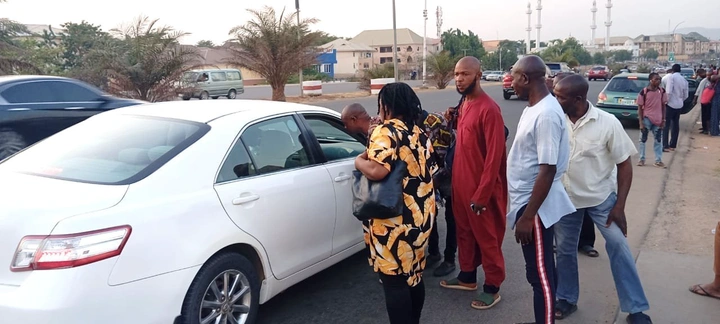
Many residents of the Federal Capital Territory (FCT), Abuja, now spend several minutes bargaining with drivers for affordable transport as fares continue to rise across the city following recent increases in fuel prices.
Daily Trust reports that major filling stations across several states have adjusted the pump price of Premium Motor Spirit (PMS), also known as petrol.
In response, commercial drivers have increased transport fares on many routes within the city, forcing commuters to dig deeper into their pockets.
In Abuja, several residents told our correspondent that they now negotiate fares before boarding vehicles in order to avoid embarrassment or being forced to alight midway if they cannot meet the fare demanded by drivers.
The development comes amid growing concerns about the impact of tensions in the Middle East on global crude oil supply and pricing, particularly the escalating conflict involving the United States, Israel, and Iran.
Many residents who spoke to our reporter described the rising pump price of petrol and the resulting transport fare hikes as worrisome and increasingly difficult to cope with.
Mr. Stanley Uwalaka, a furniture designer who commutes daily from Apo to the Dei-Dei building materials market, said he has been spending significantly more on transportation over the past three weeks, a situation he says is eating into his earnings.
“Before now, I spent between ₦3,500 and ₦4,000 daily for my trips, but with the recent increase, I now spend much more,” he said.
“From Apo Roundabout to Dei-Dei Junction, I used to pay about ₦1,300, but it has gone up to ₦1,600. Sometimes I end up begging the driver for a reduction.”
He added that some commercial drivers are unwilling to negotiate.
“Some drivers don’t want to hear ‘abeg’ when you ask for a reduction, so I sometimes wait for private drivers who may agree to give a small discount,” he said.
Similarly, a trader identified simply as Mummy Joy, who sells bananas and groundnuts around the Federal Secretariat, said the rising cost of transportation is beginning to make her business less viable.
“Why I left Mararaba to come and sell here is because there are more customers in this area. But it will not make sense if I end up spending most of my income on transportation,” she said.
She added that many traders who used to come from nearby communities are beginning to reconsider the daily commute.
“Most of the women who used to sell here are no longer coming because of the cost of transportation. I have already decided that from next week I may stop coming until the price comes down,” she said.
However, some commercial drivers say they should not be blamed for the increase in transport fares, arguing that the rise in fuel prices and vehicle maintenance costs has forced their hand.
A commercial taxi driver who identified himself as Paul, popularly called “Oga Paul” by passengers, said drivers are merely adjusting to economic realities.
“People are accusing drivers of increasing prices, forgetting that the price of fuel last month is not the same today,” he said.
“Nobody should blame us because we charge based on how much we buy fuel. If the price comes down, we will adjust our fares as well.”
Paul said he once considered converting his vehicle to Compressed Natural Gas (CNG) as an alternative to petrol but abandoned the idea due to logistical challenges.
“I thought about converting my car to CNG, but the difficulty of accessing refilling stations discouraged me,” he said.
“For many of us, this situation is not what we wished for, but the system is getting harder and everyone is feeling the impact.”
A civil servant who asked not to be named also said the rising fuel price has forced him to adjust how he uses his personal vehicle.
“Before now, I sometimes carried people at a discounted rate or even for free. But now, because of the cost of fuel, I occasionally pick passengers along the road to help cover my expenses, although I still charge less than commercial drivers,” he said.
Daily Trust findings show that transport fares have increased on several major routes in Abuja.
The fare from Berger Roundabout to Zuba has risen from ₦1,500 to about ₦1,800, while commuters travelling from Nyanya to Jabi Garage now pay around ₦1,700.
From Area 1 to Ministers’ Hill, fares average about ₦700, while the fare from Jabi Garage to Area 1 via Apo Roundabout has increased from ₦500 to ₦700.
In Mararaba, an Abuja suburb in neighbouring Nasarawa State, fares for Coaster buses have increased from ₦500 to about ₦700.
Similarly, commuters travelling from Mpape, near Maitama, to Jabi Garage now pay between ₦1,000 and ₦1,200, up from the previous ₦800.
Other increases include Lugbe to Berger Roundabout at about ₦1,000, Berger Roundabout to Karmo at ₦700 (up from ₦500), and Kuchigoro to the Federal Secretariat where fares have risen from ₦500 to ₦800.
Commuters travelling from Life Camp to Wuse Market now also pay around ₦800, compared to the previous ₦500.