
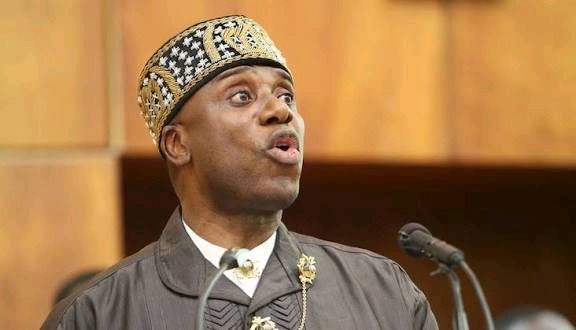
Former Minister of Transportation Rotimi Amaechi has raised concerns about the progress of the widely discussed Lagos–Calabar Coastal Highway project while reflecting on infrastructure initiatives executed during his time in office.
Amaechi made the remarks in a video circulated online by Symfoni TV, where he urged Nigerians to carefully examine the performance of the ruling All Progressives Congress before deciding which political party to support in upcoming elections.
Speaking in the video, the former minister emphasized the need for voters to focus on measurable achievements and visible development projects when evaluating the record of any administration.
According to him, citizens should ask critical questions about what tangible infrastructure projects have been delivered and how those projects have impacted the lives of ordinary Nigerians.
Amaechi specifically referenced the widely publicized Lagos–Calabar Coastal Highway, a massive road project intended to connect major coastal cities across southern Nigeria. The initiative has generated significant public attention in recent months due to its scale and projected economic impact.
However, Amaechi questioned the current status of the project, suggesting that Nigerians should seek clarity about its progress.
“If you want to vote for APC, the question you ask yourself is: what have they done?” Amaechi said while addressing the issue. He added that much of the public discussion had centered on the Lagos–Calabar Coastal Highway, prompting him to ask where the project currently stands.
The former minister then shifted his remarks to projects executed during the administration of former President Muhammadu Buhari, under whom he served as Minister of Transportation.
Amaechi pointed out that several railway projects initiated during that period remain visible and operational, stressing that they continue to provide transportation services to Nigerians regardless of political affiliation.
Among the projects he mentioned was the Itakpe–Warri Railway Line, which he described as a completed rail corridor that continues to operate and serve passengers.
He also highlighted the Lagos–Ibadan Railway, noting that the rail line has remained in use since its commissioning and serves travelers from different parts of the country.
According to Amaechi, the railway network developed during the Buhari administration was designed to benefit all Nigerians regardless of their political affiliations, adding that members of both the ruling and opposition parties make use of the rail services.
The former minister also referred to the Kano–Kaduna Railway, stating that construction work on the line had already begun before the end of the Buhari administration.
However, he acknowledged that he was uncertain about the current progress of the project since he left office.
In addition, Amaechi mentioned the Abuja–Kaduna Railway, which was completed during the Buhari era and has become one of the most heavily used rail routes in Nigeria.
The line, which connects the Federal Capital Territory to Kaduna State, has served as a critical transportation alternative for commuters and travelers, particularly during periods of heightened security concerns on the Abuja–Kaduna highway.
Amaechi used these examples to argue that infrastructure projects undertaken during his tenure can still be seen and utilized by the public.