
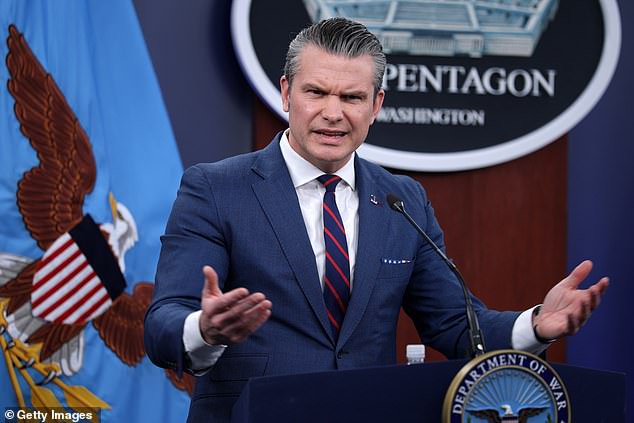
The Pentagon has reportedly banned photographers over ‘unflattering’ images from Pete Hegseth’s briefings.
The Defense Secretary’s staff were livid over photos from a hearing on March 2, sources told the Washington Post.
It is unclear exactly which images Hegseth’s aides objected to, but several show the Pentagon chief with a furrowed brow and holding his hands out as he responds to a reporter’s question.
The briefing was Hegseth’s first in more than eight months after the US killed Ayatollah Ali Khamenei in an airstrike on February 28.
Major news agencies, including Reuters, Getty Images and the Associated Press, all covered the first briefing with Hegseth and General Dan Caine.
But they were banned from attending two subsequent briefings on March 4 and March 10.
The Pentagon denied that the photographers’ exclusion was related to the substance of their images, instead claiming that there is limited space inside the briefing room.
‘In order to use space in the Pentagon Briefing Room effectively, we are allowing one representative per news outlet if uncredentialed, excluding pool,’ spokeswoman Kingsley Wilson said.
‘If that hurts the business model for certain news outlets, then they should consider applying for a Pentagon press credential.’
The Pentagon refused to issue passes to media who refused to sign a new contract last year, with dozens of major outlets rejecting the strict terms.
But since the Iran war started, a special arrangement has been made to allow reporters from certain outlets in spite of the contract dispute.
The Washington Post reported that White House spokeswoman Anna Kelly turned down the chance to comment on Hegseth and his aides’ decision to block photographers.
Kelly took to X, calling the Post journalist Scott Nover who reported the story a ‘fake news reporter,’ pushing back that she declined to comment for the story.
She wrote, ‘Not true! He just didn’t like my comment because it exposes how little the Washington Post cares about access for photographers… They just fired all of their White House photographers! Fake outrage.’
Kelly also attached a screenshot of the exchange showing the exchange between the reporter where she responded to a request for comment with, ‘Didn’t the Washington Post just fire all of it’s White House photographers?’
The March 2 briefing with Hegseth and Caine was supposed to be a ‘Pentagon new media’ affair, but due to a need
However, following the publication of images that reportedly horrified Hegseth’s aides, the Pentagon has now enforced the photographic blackout.
Now, the only cameras allowed in the room belong to the Pentagon’s photographer.
‘Excluding photographers from Pentagon briefings because officials did not like how published images portrayed them shows an astonishingly poor sense of priorities in the midst of a war and is, for a public servant, not a good look,’ NPPA President Alex Garcia said. ‘A free press cannot function if government officials decide that only favorable images of public officials may be created or distributed.’
Things reached a boiling point back in October when Pentagon reporters handed over their press credentials in a dramatic walkout.
This was sparked by a new government policy that essentially sought to ban the press from uncovering certain sensitive information and requiring them to show Pentagon officials a story before publishing.
Taking the fight to the feds, the New York Times and journalist Julian Barnes have slapped the government with a lawsuit over the controversial policy. They argue the rules are a direct assault on the First Amendment.
The case is reaching a boiling point in DC, where a judge is currently mulling over the next move after Friday’s courtroom showdown.