
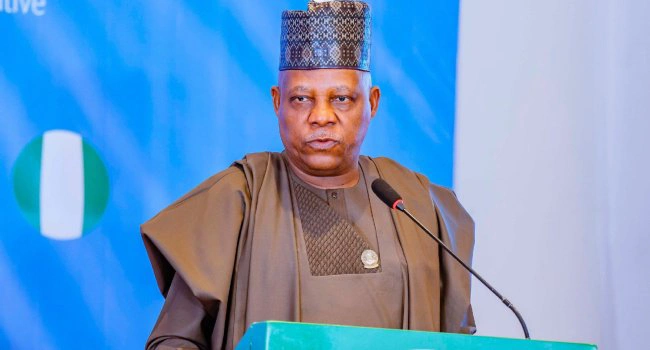
Vice President Kashim Shettima yesterday reaffirmed the resolve of President Bola Tinubu to overhaul Nigeria’s troubled power sector, declaring that the administration would not compromise on energy security as it pushes reforms aimed at unlocking investment and strengthening supply.
Speaking at the commissioning of the new headquarters of the Nigeria Electricity Liability Management Company (NELMCO) in Abuja, Shettima said the Tinubu administration was committed to building a transparent, accountable and technology-driven electricity market capable of driving national development.
He stressed that Nigeria’s economic future was closely tied to the stability of its power sector, noting that no serious nation could afford to gamble with energy security.
“What we are set to achieve requires data-driven decision-making, intelligent deployment of technology in asset management, and strong partnerships with both local and international stakeholders,” Shettima said.
He added that governance, transparency and accountability must remain central to the operations of institutions like NELMCO, describing the commissioning of the new headquarters as a symbolic turning point for the agency.
According to him, the facility should usher in a new era of efficiency, modernisation and forward-looking leadership in managing the financial liabilities of Nigeria’s electricity industry.
The vice president also used the occasion to call on private investors and international partners to take advantage of emerging opportunities in Nigeria’s power sector, assuring them of a stable and predictable policy environment.
“We are open for business. We are committed to creating a transparent and investor-friendly environment. Institutions like NELMCO show that we are not only serious about reform, but capable of sustaining it,” he said.
In his remarks, the Minister of Power, Adebayo Adelabu, said the sector reforms, anchored on policy overhaul, market liberalisation and institutional strengthening, are repositioning the sector for sustainability, efficiency and increased private sector participation.
The minister described the ongoing changes as deliberate steps to build a viable and investor-friendly electricity market. Central to the reform drive, he noted, is the Electricity Act 2023, which has enabled the decentralisation of the sector and opened the door for subnational participation.
This, he said, has already led to the activation of 16 state electricity markets, while also stimulating competition and innovation within the industry. He added that the development of a National Integrated Electricity Policy, the first in over two decades, now provides a unified framework for implementing the Act, strengthening coordination between federal and state governments and accelerating access to reliable and affordable electricity.
Adelabu further disclosed that the reforms have attracted over $2 billion in fresh investments into the sector, while ongoing efforts to transition the industry towards full commercialisation have significantly improved its financial outlook. According to him, sector revenue grew by 70 per cent in 2024, while government liabilities were reduced by about N700 billion, reflecting improved efficiency and cost recovery mechanisms.
The minister also pointed to improvements in generation capacity, which has increased from 13 gigawatts to 14 gigawatts, alongside record operational milestones, including a peak generation of 5,801.44 megawatts.
He said the government is addressing the long-standing metering gap through the Presidential Metering Initiative (PMI), backed by N700 billion mobilised through the Federal Account Allocation Committee (FAAC) and an additional $500 million World Bank facility, with procurement processes already underway to deliver millions of meters nationwide.
According to the minister, NELMCO has reduced inherited liabilities from N2.303 trillion to N146.76 billion and delivered over N700 billion in savings to the federal government through rigorous verification and reconciliation processes.
He added that NELMCO has also significantly reduced ground rent claims from N644 billion to N41.8 billion and achieved a 45 per cent reduction in post-privatisation liabilities owed by Ministries, Departments and Agencies (MDAs) to electricity distribution companies.
In his remarks, the Minister of Finance and Coordinating Minister of the Economy, Wale Edun, who also serves as Vice Chairman of NELMCO’s board, said efforts to stabilise the power sector would have far-reaching benefits for small and medium-scale enterprises and the broader economy.
He noted that ongoing reforms under the Tinubu administration, including the establishment of the Grid Asset Management Company, were designed to address structural weaknesses and improve efficiency across the electricity value chain.
On the legislative side, Chairman of the Senate Committee on Power, Enyinnaya Abaribe, represented by Senator Oyelola Ashiru, said the new NELMCO office would reduce government spending on rent while enhancing operational efficiency.
He reaffirmed the commitment of the National Assembly to provide the legal and regulatory support required for agencies in the power sector to deliver on their mandates.
Earlier, Managing Director and Chief Executive Officer of NELMCO, Mojoyinoluwa Dekalu-Thomas, said the agency had evolved from a liability management firm into a strategic stabiliser within the electricity value chain.
She disclosed that since its inception following the unbundling of the defunct Power Holding Company of Nigeria, NELMCO had been tasked with managing enormous legacy debts that once threatened the success of the sector’s privatisation.
Dekalu-Thomas added that beyond debt resolution, NELMCO had generated over N30 billion in revenue for the federal government through the sale and lease of non-core assets.
She explained that by clearing legacy obligations, the agency created the financial stability needed for successor companies in the sector to attract investment and focus on service delivery.
Looking ahead, she said NELMCO would transition into a strategic asset custodian, leveraging advanced data systems to optimise power sector assets and support liquidity.
She noted that the agency would also play a critical role in ensuring a smooth transition to state-regulated electricity markets under the new legal framework, while providing risk mitigation mechanisms for investors.
Describing the new headquarters as a “centre of excellence,” she said it would house a national register of power assets and serve as the hub for managing the complex financial architecture of the sector.
“As we move into a decentralised electricity market, NELMCO will remain the bridge between past liabilities and future opportunities,” she said.
Also, against the background of Nigeria’s deteriorating electric power crisis, a leading Nigerian energy expert, Prof Bart Nnaji, has outlined a number of measures he says the country has to take immediately to arrest the situation.
Delivering the 30th, 31st and 32nd graduation lecture of the Abia State University at Uturu, Nnaji, a former Minister of Power, outlined the steps as the restoration of the power purchase agreements (PPAs) between electricity firms and the federal government which the President Muhammadu Buhari administration suspended, the payment of the N6.8 trillion owed the power generation firms and the over N200 billion owed distribution companies, and allowing DisCos to charge cost-reflective tariffs.