
As a student activist in Sudan under Brotherhood rule, I learned what it meant to hold views the regime considered unforgivable. Calling for democracy, liberalism, and secularism carried the constant threat of imprisonment, torture, or death.
So, when U.S. Secretary of State Marco Rubio designated the Sudanese Islamic Movement (SIM) and its armed wing, the al-Baraa Bin Malik Brigade, as terrorist organizations last week, I recognized what the designation finally acknowledges. But the Sudanese Muslim Brotherhood is not a product of the conflict that erupted in April 2023. It is the architect of the political order that made that conflict inevitable. Understanding how the Brotherhood evolved from an ideological movement into a military force; and why the United States finally acted; requires tracing a lineage that stretches back over seven decades.
From Campus Politics to State Capture
The Sudanese Muslim Brotherhood was founded in 1954, modeled on its Egyptian parent organization but shaped by distinctly Sudanese conditions. For its first three decades, the movement operated primarily within universities and professional unions, building a cadre of ideologically committed members who would later occupy key positions in government, the military, and the judiciary. Its transformation from a social movement into a political force was driven almost entirely by one man: Hassan al-Turabi.
Turabi, a Sorbonne-educated legal scholar, understood that the Brotherhood could not seize power through elections alone in a country as ethnically and religiously diverse as Sudan. His strategy was institutional infiltration. By the 1980s, Brotherhood members had penetrated the officer corps of the Sudanese Armed Forces, the banking sector through Islamic finance institutions, and the intelligence services. When General Omar al-Bashir launched his coup on June 30, 1989, it was Turabi’s National Islamic Front (NIF), the Brotherhood’s political vehicle, that provided the ideological blueprint and the civilian governance apparatus. The coup was not a military takeover that the Brotherhood later co-opted; it was a Brotherhood project executed through military means.
The Bashir Era: Islamism as State Policy
Under the Bashir-Turabi partnership, Sudan became a laboratory for political Islam in Africa. The regime-imposed Sharia law on a multi-religious population, purged secularists and moderates from state institutions, and transformed the security services into instruments of ideological enforcement. Khartoum became a haven for Islamist militants from across the region, including, for a period in the early 1990s, Osama bin Laden. The Brotherhood’s influence extended into every dimension of governance, education curricula were rewritten, media was subjected to Islamist censorship, and civil society organizations were either absorbed into the movement or destroyed.
The Brotherhood’s project was not an abstraction to Darfuris; it was the ideology that justified the marginalization of non-Arab and non-Islamist communities across Sudan’s peripheries. The same security apparatus that Turabi built, and that the Brotherhood staffed, would later oversee the genocide in Darfur beginning in 2001. The Janjaweed militias that carried out the killings were armed and directed by a state whose governing ideology was the Brotherhood’s.
When Bashir was overthrown by popular revolution in April 2019, the Brotherhood did not disappear. It retreated into the very institutions it had spent thirty years building: its networks within the military, intelligence, and economy remained intact.
The Brotherhood at War
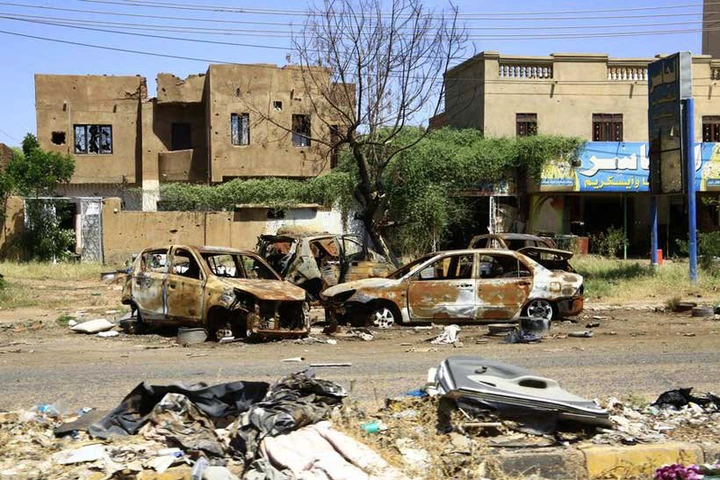
When civil war broke out between the Sudanese Armed Forces and the Rapid Support Forces in April 2023, the Brotherhood saw an opportunity to reclaim the state it had lost. The Sudanese Islamic Movement mobilized the al-Baraa Bin Malik Brigade, a fighting force that the U.S. State Department now estimates at upwards of twenty thousand combatants. These are not irregular. They are ideologically trained fighters, many of whom received direct support from Iran’s Islamic Revolutionary Guard Corps, as I detailed in my previous article.
The depth of the Brotherhood’s control over the SAF is no longer a matter of speculation. A leaked video, reported by Sky News Arabia, showed a senior Brotherhood figure openly declaring that General al-Burhan serves merely as the public face of the military while the Islamist organization exercises actual command over the army’s strategic direction. This admission aligns with what many Sudanese analysts have long argued: that the Sudanese Islamic Movement, operates as the real power behind the military’s war effort. Its network supplies the SAF with manpower, financing, and public mobilization capacity that al-Burhan’s conventional military structure cannot generate on its own. In return, the Brotherhood secures its grip over Sudan’s institutions and positions itself to dominate the post-war political order.