
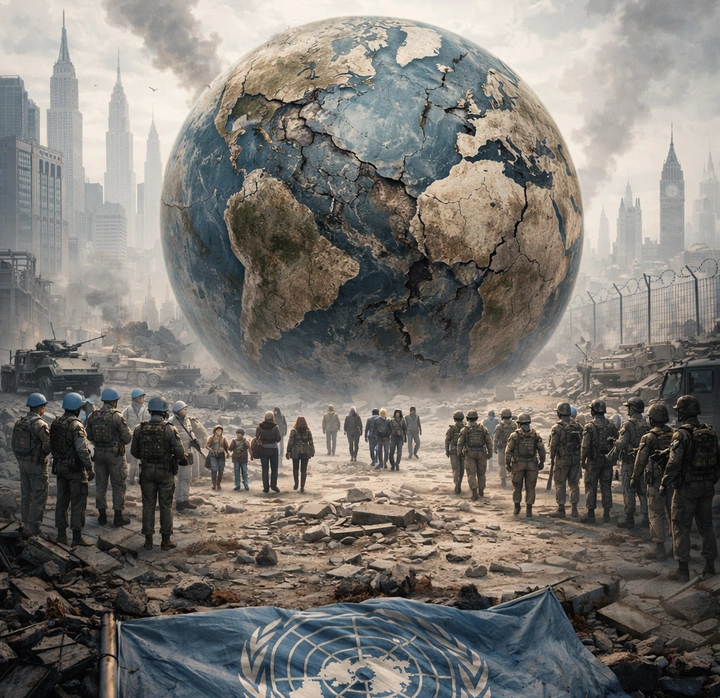
The world woke on Saturday, February 28, 2026, to the most aggressive operation and deployment of the most sophisticated weaponry since World War II, as the Israeli Defence Forces (IDF) and the U.S. military began an unprovoked coordinated strikes against Iranian leadership, their residences, missile infrastructure, air defence systems, and command centres. Armed with a regime change agenda, they assassinated Iranian Supreme Leader Ali Khamenei and other high-ranking officials.
With the poundings and left with no other option, Iran made good its threat to take the fight to U.S. security partners, assets, and personnel in the region if attacked. Since then, it has been raining missiles and drones not just on Israel but also on all American strategic military bases and interests in Saudi Arabia, Qatar, Kuwait, Bahrain, Iraq, the United Arab Emirates (UAE), Jordan, and Oman. In further pressure, Iran has closed the Strait of Hormuz, leading to soaring oil prices and disruptions in global markets. The conflict has drawn in proxies like Hezbollah in Lebanon and Houthi rebels in Syria and Yemen.
Expectedly, the Middle East has become the world’s most dangerous flashpoint, bringing to the front burner its convergent challenges of energy security, religion, sovereignty, international human rights law, and great power competition for dominance. China’s Foreign Minister, Wang Yi, on Sunday in Beijing condemned the war that “should never have happened.” He added: “A strong fist does not mean strong reason. The world cannot return to the law of the jungle.”
But the belligerence which started the war is still in play. President Donald Trump, who earlier demanded Iran’s surrender, boasted that “everything they (Iran) have is gone, including their leadership.” But the Islamic Revolutionary Guard Corps (IRGC) said they would “determine the end of the war” and that Tehran would not allow “one litre of oil” to be exported from the region if U.S. and Israeli attacks continue.
We at Daily Trust believe that the attack on Iran has put a knife to the United Nations (UN) as a global consensus platform, as it violated Article 2(4) of the UN Charter, which prohibits the use of force against states. Moreover, up till now, neither the U.S. nor Israel has produced any verifiable evidence of Iran posing any imminent threat to them.
It is regrettable that the UN Security Council (UNSC) has shown an unprecedented paralysis outside condemnations, emergency Security Council meetings, and calls for de-escalation. There was no binding resolution condemning the attack. But it is instructive that on the 12th day of the war, the UN Security Council jerked up to duty and passed a resolution calling for Iran to immediately halt its attacks on Gulf states, as they “breach international law” and pose a “serious threat to international peace and security.” It also “condemns any actions or threats by the Islamic Republic of Iran aimed at closing, obstructing, or otherwise interfering with international navigation through the Strait of Hormuz.”
We, therefore, call on the UN to wake up from its slumber and lead the search for peace. We also call on European leaders to drop the seeming hapless posture, as if they are walking on eggshells of fear. In the same vein, we call on China and Russia to go beyond abstaining in the UNSC resolution and lead the charge for a ceasefire and peace in the region.
Daily Trust urges all men and women of conscience to work for a new world where there should be an absence of dubious entitlement to power, belligerence, and the re-writing of the rule book in international law where might is right, and where the United Nations and other multilateral institutions of the international system matter.
We also urge the Nigerian government to continue the path of restraint and a prudent, non-aligned stance, avoiding entanglement in the crisis, as any wrong move could trigger domestic polarisation.
We also urge the federal government to maintain enhanced and proactive chancery monitoring and a robust standby crisis architecture in case there is need for the evacuation of Nigerians, drawing from the lessons from past global crises — Libya, Ukraine, and Sudan.
Specifically, we call for an immediate end to the nightmare that the war has become. Backing down and negotiating a ceasefire and ending the war makes a lot more sense. After all, any thought that this war will bring lasting stability in the region has fizzled out. In fact, it makes it a whole lot harder.
We believe that wars should no more be fought on the whims of leaders but on an international consensus that prohibits irascible acts and behaviour. What is required is a world ruled by international law where powerful states are restrained from dominating or attacking weaker ones. This ill-timed “war of choice,” which has wrought an unprecedented scale of destruction and killings, must stop immediately. And we insist that the use of force without consideration for the rule of law in the international arena should never be made the new normal.