
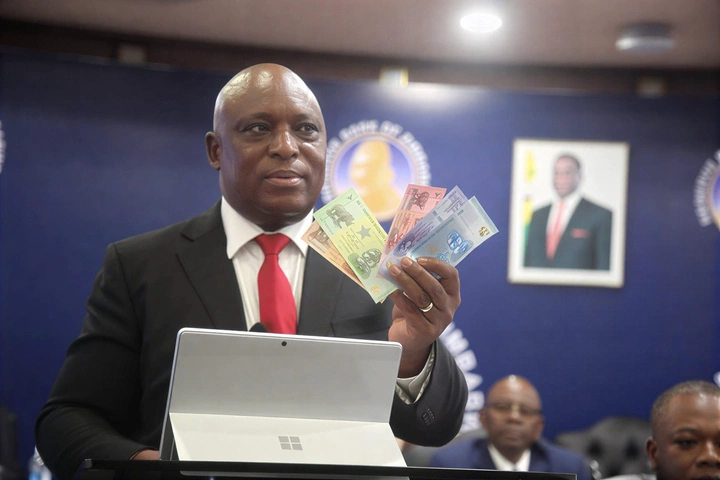
HARARE – In the bustling streets of Harare and the industrial hubs of Bulawayo, a quiet but profound transformation is taking root, one that threatens to dismantle the decade-long dominance of the United States dollar in Zimbabwe’s economy. While the Reserve Bank of Zimbabwe (RBZ) has long maintained a narrative of “multi-currency coexistence,” recent high-level directives and candid admissions from senior officials suggest a far more aggressive agenda: the permanent phasing out of the US dollar in favour of the Zimbabwe Gold (ZiG) currency.
The revelation came from the very heart of the central bank. Reserve Bank of Zimbabwe deputy governor Innocent Matshe, speaking at the Zimbabwe Impact Investment Dialogue on Tuesday, April 21, 2026, outlined a long-term strategy that aims to restore “monetary sovereignty” by anchoring the entire economy on the ZiG. Matshe’s words were carefully chosen but their implication was unmistakable. “What will happen is you won’t be able to go to the supermarket and use your U.S. dollars,” Matshe told a room of policymakers and investors, including representatives from the United Nations Development Programme (UNDP) and the Zimbabwe Investment and Development Agency (ZIDA).
This transition to a mono-currency system, Matshe noted, would be gradual—”Not soon, but one day”—yet the mechanisms for this “one day” are already being rapidly deployed. The government has shifted from its previously fixed 2030 de-dollarisation target to a “conditions-based” framework under its 2026–2030 Strategic Plan. This subtle change in language is significant; it allows the state to declare the “conditions” met at any moment, potentially accelerating the transition and catching the private sector off-guard.
The most visible sign of this accelerating shift occurred in March 2026, when Finance Minister Mthuli Ncube issued a sweeping directive mandating the exclusive use of ZiG for all local government procurement. This instruction, subtly embedded within a broader announcement concerning a National Standard Price List (NSPL), marks a determined effort to de-dollarise the nation’s public sector from the top down. The directive stipulates that all ministries, departments, and agencies (MDAs), alongside state-owned enterprises and local authorities, must now settle payments with local suppliers solely in the domestic currency.
The Treasury frames this policy as a crucial step to enhance transparency and rectify the long-standing issue of price inconsistencies within public procurement. However, for many astute economic observers, the true significance of this development lies not merely in administrative reform, but in a calculated attempt to integrate the private sector more deeply into a ZiG-centric financial system. By forcing contractors to accept ZiG, the government is artificially inflating demand for the local currency.
“Government is, therefore, commended for taking a lead and a bold step in settling all its local suppliers and contractors exclusively in local currency, ZiG,” RBZ Governor Dr. John Mushayavanhu stated in support of the move. He attempted to placate fears by adding: “The Reserve Bank further advises the public that the stance taken by the Government to pay its local suppliers and contractors exclusively in ZiG does not signal the end of the multicurrency system.”
Yet, on the ground, the sentiment is far more sceptical. One Harare-based economist, who requested anonymity due to the sensitivity of the matter, remarked, “The price standardisation on its own is unremarkable – governments do that. What stands out is insisting that every supplier payment will be in ZiG. That’s not a procurement reform. That’s currency policy dressed up as procurement reform.”
The “Dual-Track” Inconsistency: A Credibility Deficit
Perhaps the most glaring obstacle to the ZiG’s widespread acceptance is the government’s own reluctance to fully embrace the currency it promotes. While suppliers are now compelled to accept ZiG for their services, the state itself continues to demand payment in US dollars for essential public services. Passports, various civil documentation, and even fuel purchases are still predominantly priced and payable in foreign currency.
This “dual-track” system has led to accusations of inconsistency and a perceived lack of genuine confidence in the ZiG. “You cannot tell suppliers to accept ZiG while you yourself demand dollars for passports. That kind of selective application destroys the credibility of any monocurrency narrative. People aren’t blind to the inconsistency,” the anonymous economist added.
This sentiment finds resonance with the Zimbabwe Congress of Trade Unions (ZCTU), which recently rejected Minister Ncube’s calls for “realistic” wage demands. The ZCTU contends that the Minister’s perspective overlooks the fact that approximately 84% of the Zimbabwean economy operates informally and largely transacts in US dollars. For the average worker and small-scale entrepreneur, the US dollar is not merely a preference but a vital tool for economic survival in a market where the ZiG’s purchasing power is often regarded with considerable scepticism.
Decoding the “Fundamentals” vs. Market Reality
The RBZ frequently cites “macroeconomic fundamentals” to justify its confidence in the ZiG. They point to inflation, which reportedly plunged to a three-decade low of 3.8 percent in February 2026, and foreign currency receipts that surged to US$16 billion in 2025. RBZ Governor Mushayavanhu has even claimed that the ZiG is undervalued by nearly half, pointing to the substantial foreign reserves and gold backing the currency.
Indeed, by late 2025, Zimbabwe’s gold reserves had reportedly reached US$1.1 billion, sufficient to cover around 1.2 months of imports. This is a significant increase from previous years, and the central bank has used this to project an image of stability. However, the market’s verdict is far more nuanced.
|
Exchange Rate Type
|
Rate (ZiG per 1 USD)
|
Source/Date
|
|
Official Interbank Rate
|
25.25
|
RBZ (April 21, 2026)
|
|
Black Market Rate (Cash)
|
40.00
|
Market Survey (April 20, 2026)
|
|
Early 2026 Interbank
|
26.95
|
Treasury Reports
|
|
Introductory Rate (April 2024)
|
13.56
|
RBZ Launch Data
|
The significant disparity between the official interbank rate and the parallel market rate—often 1.5 to 3 times higher—places considerable pressure on businesses that supply the government. These companies must now align their pricing with the NSPL benchmarks and accept payment in ZiG, even as they are often compelled to source their own inputs and raw materials in a market where hard currency remains the predominant requirement.
The ZiG suffered a massive 43 percent devaluation by September 2024, just months after its launch. While it reportedly firmed by 1.5 percent against the US dollar in early 2026, the rapid depreciation in its first year exposed the fragility of the “gold-backed” promise. If the fundamentals were truly sound, critics argue, a currency backed by precious metals would not lose nearly half its value in such a short period.
Echoes of the Past: The Ghost of Bond Notes and RTGS
To understand the deep-seated distrust among Zimbabweans, one must look at the nation’s traumatic monetary history. The ZiG is not an isolated experiment; it is the latest in a long line of failed currencies, each introduced with grand promises and ending in financial ruin for the populace.
In 2016, the RBZ introduced Bond Notes, a “surrogate” currency purportedly backed by a US$200 million Afreximbank facility. The government insisted that the Bond Note was valued at 1:1 with the US dollar. The public, however, quickly realised the deception. The lack of transparency and excessive printing led to a thriving black market, and the Bond Note rapidly lost its value, becoming little more than “zombie money.”
The most devastating blow came in 2019 with the introduction of the RTGS dollar. Through Statutory Instrument 33 of 2019 (S.I. 33/2019), the government decreed that all local US dollar balances were converted to RTGS dollars at a 1:1 parity. This legal manoeuvre was described by many as a state-sanctioned heist. Because the RTGS dollar immediately plummeted in value against the real US dollar, the 1:1 decree effectively wiped out the value of private savings, pensions, and corporate balance sheets.
The Law Society of Zimbabwe challenged this decree, noting that it “wiped out billions of dollars in value from individual savings, as well as pensions.” Yet, the Supreme Court upheld the government’s actions, cementing the loss for millions of Zimbabweans. The parallels between the 2019 RTGS conversion and the current ZiG strategy are chilling. In both instances, the government utilised a liquidity crunch to force a transition, and in both instances, they relied on legislative decrees to mandate the use of a local currency.
Enforcement: Charm, Force, and the Black Market
The government’s strategy to promote the ZiG has been a mix of “charm and force.” While officials use seminars and investment dialogues to project confidence, the security apparatus has been deployed to suppress any perceived threats to the currency’s stability.
Authorities have packed jail cells with dozens of street currency dealers and frozen the accounts of businesses accused of “undermining” the ZiG through parallel market activities. In May 2024, a major crackdown saw illegal money traders virtually disappear from the streets of Harare, though they soon returned in more clandestine forms. Interestingly, Al Jazeera reported in late 2025 that some police were becoming more “lenient” toward disabled black market dealers, who have found themselves caught in the crossfire of the currency war.
“The work we do is illegal,” one disabled dealer told Al Jazeera, “but it is the only way we can survive in an economy that does not provide for us.” This highlight’s the human cost of the currency transition—a struggle for survival in a landscape where the rules change overnight.
The Mining Sector and the Quest for Reserves
The mining sector, a key contributor to Zimbabwe’s foreign currency reserves, remains central to the RBZ’s plans. Deputy Governor Matshe has sought to reassure miners that their foreign currency needs will be met. “This country is generating a lot more foreign currency, that is really important,” Matshe said. “So in terms of, if you have funding and you need foreign currency, you will get foreign currency. So there is absolutely no reason for miners to worry.”
The RBZ recently claimed to have cleared all outstanding foreign currency payment receipts, paying up approximately US$60 million that was outstanding from the auction system. This move was intended to signal that the central bank’s coffers are healthy and that it can manage the nation’s external obligations. “I can assure you that over the last 12 months, the rate at which we accumulated these results has been nothing but something that I can say was outstanding,” Matshe stated, referring to the growth in reserves.
The Digitalization Gamble
As part of the broader reform, the RBZ is also pushing for the digitalization of all financial systems. Matshe acknowledged that many current systems are “slow, manual, and not open,” which hinders the efficiency of the ZiG. “We are on a programme to digitalise all of our systems,” he noted, suggesting that a more modern, transparent infrastructure would help build the trust that is currently lacking.
However, digitalization alone cannot solve the fundamental issue of trust. If citizens believe that the ZiG can be manipulated or devalued at the whim of officials, they will be reluctant to embrace it, regardless of how efficient the digital platform might be. The pervasive shadow of corruption in Zimbabwe continues to undermine confidence in all institutions, including the central bank.
Conclusion: A High-Stakes Leap of Faith
The RBZ’s gamble on the ZiG is a high-stakes one. If successful, it could pave the way for greater economic sovereignty and stability, finally breaking the cycle of hyperinflation and currency collapse. However, if it fails, it could further erode public trust and plunge the country into an even deeper economic crisis.
For many Zimbabweans, the ZiG represents yet another leap of faith. The memories of 2008, 2016, and 2019 are still fresh, and the “gold-backed” promise is viewed with a mixture of hope and deep-seated suspicion. The government’s recent moves—forcing contractors to accept ZiG while demanding US dollars for its own services—suggest a state that is not yet fully committed to the path it is forcing its citizens to take.
As the US dollar is gradually squeezed out of domestic transactions, the question remains: is the ZiG a bridge to a brighter economic future, or is it merely another painful reminder of past failures? The “GoodBye US$” headline may be a government aspiration, but for the people of Zimbabwe, the real goodbye will only happen when they can trust the money in their pockets as much as they trust the gold in their hills.
Until then, the stealth transition continues, one procurement directive and one investment dialogue at a time, leaving a nation to wonder if they are witnessing a genuine economic rebirth or the final act of a sophisticated financial shell game.