
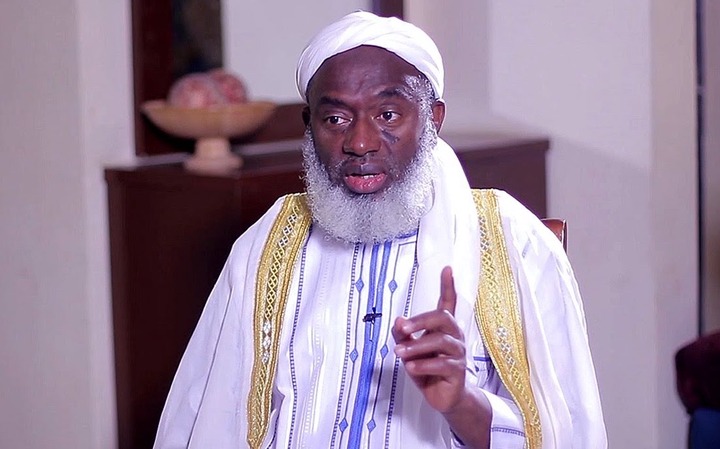
Islamic scholar Abubakar Ahmad Gumi has called for a reassessment of approaches to conflict and terrorism, warning that continued cycles of violence may persist without strategic dialogue and structural interventions.
Gumi made the remarks in a statement posted on his official Facebook page on Wednesday, April 22, 2026, where he addressed both global tensions and Nigeria’s internal security challenges.
He began by referencing recent geopolitical developments, stating, “Recently, Iran, in response to threats from the United States, declared that if its civilian infrastructure were attacked, it would retaliate by targeting power stations and desalination facilities in neighboring Gulf Arab states.”
Explaining the implications, he added, “In essence, the message is clear: if I cannot strike you directly, I will strike your closest allies as a form of deterrence. It is a warning that says—if you truly value your partners, then restrain your aggression.”
Gumi noted that such dynamics reflect broader realities of modern conflict. “This reflects the grim reality of a world where no single actor holds a monopoly over the means of violence. Power is diffused, and retaliation is no longer confined to confrontation,” he stated.
He further observed, “Unfortunately, those perceived as superior powers often resist compromise. They hesitate to accept what they interpret as the humiliation of ‘defeat’ at the negotiation table. This is where Pakistan has stepped in—as a mediator helping to de-escalate tensions and prevent further escalation.”
Drawing parallels to Nigeria, Gumi said, “Now, consider this broader scenario in relation to the fight against terrorism in Nigeria. As long as Nigeria’s borders remain porous, and the government struggles to control the influx of illegal weapons, drugs, and explosives, the cycle of violence will persist.”
He highlighted the impact on civilians, stating, “When terrorists are targeted, they often retaliate by attacking the most vulnerable populations—the very people the government is meant to protect. Conversely, when the government intensifies its military response, civilians frequently suffer as collateral damage.”
Gumi stressed the importance of understanding underlying causes. “A common question is: What do these terrorists actually want? This question lies at the heart of the issue—and misunderstanding it is one of the gravest mistakes people make. Without understanding the root causes of terrorism, any attempt to combat it risks being misguided,” he said.
He concluded by advocating engagement as part of a broader solution. “The way out of this deadlock may lie in what could be called a ‘Pakistan-style’ circuit breaker—a peace broker capable of facilitating dialogue and reducing tensions. The lesson is clear: lasting solutions require realism, dialogue, and strategic understanding—not just force,” Gumi stated.