
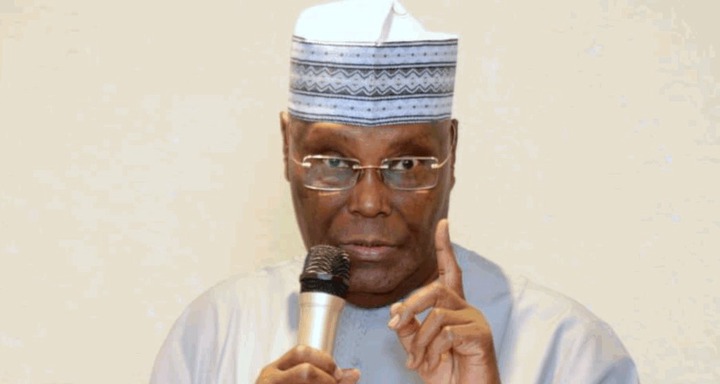
According to a report by Punch on Sunday, April 19, 2026, former Vice President Atiku Abubakar has strongly criticised the economic policies of President Bola Ahmed Tinubu’s administration, arguing that Nigeria’s rising debt profile has not translated into tangible development or improved living conditions for citizens.
Atiku’s remarks came in response to recent comments and assessments by the International Monetary Fund (IMF), which reviewed Nigeria’s economic trajectory amid ongoing concerns about inflation, currency pressure, and the escalating cost of living.
He maintained that the IMF’s position merely confirmed the reality already being experienced by ordinary Nigerians, insisting that the country’s economic situation has continued to deteriorate under current policy directions.
The statement was issued through his Senior Special Assistant on Public Communication, Phrank Shaibu, who outlined Atiku’s position on the state of the economy and what he described as policy-induced hardship affecting millions of households.
According to the former Vice President, the issue is not simply about external assessments but about the daily struggles faced by citizens who are grappling with rising food prices, transportation costs, and general economic instability.
Atiku argued that Nigeria’s borrowing pattern has become unsustainable, stating that successive financial commitments have not resulted in visible infrastructure development or improved social services.
Speaking through Shaibu, Atiku said, “We are borrowing like there is no tomorrow, yet there is nothing to show today.”
He further stated that the IMF report only reinforced long-standing concerns raised by opposition voices and economic observers who believe that fiscal policy decisions have not delivered inclusive growth.
Atiku also described the prevailing situation as “organised hardship,” suggesting that current economic reforms, while intended to stabilise the economy, have instead deepened the suffering of the population.
He argued that inflationary pressures and currency devaluation have eroded purchasing power, leaving many Nigerians unable to afford basic necessities despite government assurances of recovery.
The former Vice President stressed that economic indicators must be matched with real-life improvements in citizens’ welfare, warning that macroeconomic stability alone is insufficient if it does not translate into improved living standards.
He also questioned the effectiveness of recent fiscal and monetary measures, insisting that policy execution must prioritise productivity, job creation, and food security to achieve meaningful recovery.