
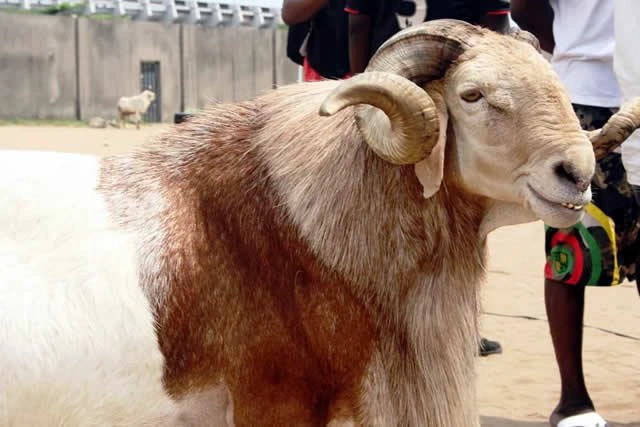
ABUJA – Days before Eid-el-Kabir, the dusty livestock section of Dei-Dei market in Abuja should ordinarily be overflowing with noise, bargaining and excitement.
Traders shouting prices. Buyers dragging reluctant rams by ropes. Children laughing and posing beside fat white sheep marked for sacrifice.
But this year feels different. The crowd is thinner. The bargaining is quieter. And many of the men who walk through the market do so with hands behind their backs — not because they are relaxed, but because they already know they cannot afford what they came to buy.
Near a row of exhausted-looking rams tied beneath a zinc shed, 43-year-old civil servant, Musa Ibrahim, stared silently at a medium-sized ram priced at N850,000.
He bent briefly to inspect the animal’s teeth, stood up slowly and shook his head.
“Last year, I bought something bigger than this for N420,000,” he said. “This year, I just came to look first. Maybe Allah will provide before Sallah.”
Around him, dozens of prospective buyers wandered through the market carrying calculators, phones and worried faces.
For many Muslim families across Nigeria, the traditional Sallah ram — once a proud symbol of celebration, sacrifice and communal joy — is gradually becoming a luxury item.
Across major livestock markets in Abuja, Lagos, Kano, Ibadan and Kaduna, traders, buyers and transporters say soaring inflation, insecurity, fuel prices and cross-border trade disruptions have pushed ram prices to record levels, forcing many families to either downgrade their plans or abandon the sacrifice entirely.
At Kara livestock market along the Lagos-Ibadan Expressway, ram dealer Abdulrasheed Bello said business has become painfully unpredictable.
“People still come every day,” he explained, adjusting his cap under the scorching afternoon sun. “But many only ask for prices and leave immediately.”
According to him, the cheapest ram in his section now sells between N250,000 and N350,000, while bigger breeds imported from Niger Republic and Chad cost over N1 million.
“Transport alone is killing us,” he lamented. “Before, a truck from the North cost maybe N700,000 or N800,000. Now you can spend over N2 million because of diesel, checkpoints and insecurity on the roads.”
He pointed toward a line of dusty trucks parked near the market entrance.
“Some drivers even refuse certain routes because of bandits.”
For decades, Nigeria’s Sallah livestock economy depended heavily on trans-border movement of animals from neighbouring countries including Niger Republic, Chad, Cameroon and Mali.
But traders say the system has been severely disrupted by border tensions, currency instability and rising insecurity across the Sahel region.
At Wuse market in Abuja, 34-year-old tailor, Khadijat Suleiman, said her family has already decided not to buy a ram this year.
“My husband and I discussed it,” she said quietly while shopping for foodstuff. “School fees are there. House rent is there. Food is expensive. We cannot kill ourselves because of ram.”
She said the family may instead contribute money with relatives to buy one smaller animal jointly.
“In Islam, sacrifice is according to ability,” she added. “But honestly, many people are ashamed to admit they cannot afford it anymore.”
That shame may be one of the hidden social pressures deepening the emotional burden around Sallah this year.
In many Nigerian communities, especially among middle-class families, owning a ram during Eid is more than a religious exercise. It is also tied to dignity, status and social expectation.
Children compare whose ram is bigger. Neighbours observe who slaughtered what. Families send meat to relatives and friends as proof of celebration.
But economic realities are changing those traditions.
At Oja-Oba market in Ibadan, trader Risikat Lawal said some women have started pleading with meat sellers for smaller portions because their families may not slaughter animals this year.
“Things are hard,” she said. “People are managing quietly.”
Near her stall, commercial driver Waheed Adebayo laughed bitterly when asked about buying a ram.
“Ram ke?” he exclaimed in Yoruba-inflected frustration. “I am struggling to buy fuel and feed my children.”
He said the last time he bought a ram personally was three years ago.
“Now I just join friends or relatives if they buy one.”
Economists say the disappearing purchasing power of ordinary Nigerians is directly reshaping religious and cultural celebrations.
Abuja-based economic analyst, Dr. Tunde Balogun, explained that food inflation, naira depreciation and transport costs have combined to make livestock significantly more expensive.
“Everything connected to the livestock supply chain has become costlier,” he said.
“Feed prices have risen. Transportation has become extremely expensive. Insecurity has disrupted supply routes. Currency instability affects cross-border trade. All these costs eventually reach the final consumer.”
Nigeria’s inflation crisis has altered spending patterns across households already battling rising electricity tariffs, fuel costs and high food prices.
For many families, Eid sacrifice now competes directly with survival priorities.
At Dei-Dei market, ram seller Ismail Garba said even wealthy customers are bargaining harder this year.
“Before, some people bought three or four rams without stress,” he said. “Now they spend hours pricing one.”
He recalled how one customer recently inspected nearly fifteen rams before quietly leaving without buying any.
“He told me, ‘Mallam, I cannot spend my entire salary on ram.’”
Garba himself is feeling the pressure.
He said feeding unsold animals daily has become another major financial burden.
“Grass is expensive. Everything is expensive. Even the sellers are suffering.”
Further north in Kano, livestock transporter Aliyu Dambatta said insecurity along major highways has become one of the biggest threats to the Sallah market.
“Some roads are dangerous at night,” he explained via telephone. “Drivers fear attacks. Sometimes animals are stolen during transit.”
According to him, transport unions now charge higher fees to offset security risks and rising diesel costs.
“All those expenses enter the final price.”
The situation has also affected buyers from southern Nigeria who traditionally travel northward to purchase cheaper livestock in bulk during the Sallah season.
At Bodija market in Ibadan, butcher Kareem Afolayan said many meat sellers are expecting lower sales during the Eid period.
“People who used to buy full ram meat now buy half or quarter,” he explained while sharpening a knife beside his wooden table. “Customers are calculating every naira.”
Despite the hardship, however, many Nigerians are still determined to preserve the spirit of Eid in whatever way they can.
At a modest home in Nyanya, Abuja, primary school teacher Fatima Abdullahi said her family has decided to focus more on prayers and togetherness this year rather than expensive celebrations.
“Sallah is beyond showing off,” she said as her children played nearby. “If we can afford ram, fine. If not, we thank God for life.”
Her 10-year-old son, Ahmad, interrupted the conversation with innocent honesty.
“But mummy, I still want a small ram,” he said shyly.
Fatima smiled weakly. “That is the difficult part,” she admitted.
For many children, Sallah memories are built around the excitement of feeding, decorating and eventually watching the family ram being slaughtered.
In some homes, parents now struggle emotionally with the fear of disappointing their children. At a livestock stand near Kubwa, Abuja, trader Hassan Mohammed said he has noticed increasing desperation among buyers.
“Some people beg us to allow installment payment,” he revealed. “Others come back repeatedly hoping prices will reduce.”
But according to him, prices are unlikely to fall significantly before Eid.
“If anything, they may still increase.”
Islamic clerics, meanwhile, are urging Muslims not to succumb to unhealthy social pressure.
Chief Imam AbdulHakeem Mustapha of a central mosque in Abuja reminded worshippers that Eid sacrifice is deeply spiritual and should not become a source of financial hardship or competition.
“Islam does not encourage people to suffer beyond their means,” he said.
“The essence of sacrifice is obedience, gratitude and compassion — not pride.”
He warned against borrowing recklessly or neglecting family welfare simply to maintain appearances during the festive period.
“Feeding your family and paying your obligations are also responsibilities before Allah.”
Still, in markets across the country, the emotional pull of tradition remains powerful.
At Kara market in Lagos, children surrounded a massive white ram decorated with colourful ribbons as their father negotiated aggressively with the owner.
After nearly thirty minutes of bargaining, the buyer finally walked away.
The children looked disappointed.
Their father avoided eye contact.
Not far away, trader Suleiman Adamu sat beside several unsold animals and reflected on how dramatically the Sallah market has changed over the years.
“There was a time when people happily bought ram,” he said.
“Now many people buy with fear.”
As evening approached, the market slowly emptied.
Dust rose behind departing vehicles. Traders counted the day’s earnings quietly. Unsold rams bleated restlessly beneath the fading orange sky.
And across Nigeria, countless Muslim families continued doing difficult calculations in their heads — balancing faith, family expectations and economic survival.
For some, the ram may still come before Sallah morning.
For many others, this year’s Eid celebration may happen without one.
Yet even amid hardship, Nigerians continue to adapt in the way they always have — through shared meals, communal support, humour, prayer and resilience.
Perhaps that is the deeper story hidden beneath the disappearing Sallah ram.
Not merely the rising price of livestock.
But the rising cost of living itself.
And the quiet struggle of ordinary people trying to preserve dignity, tradition and faith in difficult times.