
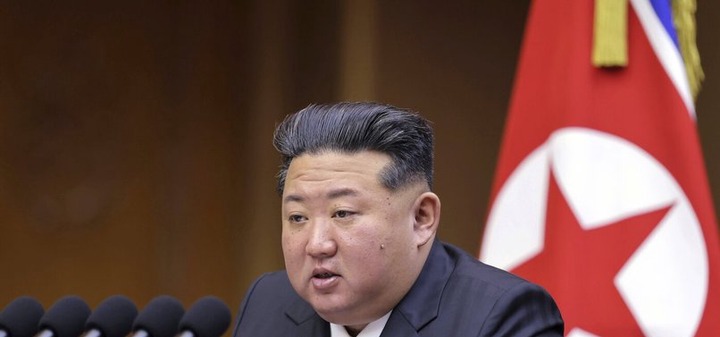
According to a report by Anadolu Agency on Thursday, May 28, 2026, North Korea has strongly rejected renewed international calls for its denuclearization, declaring that it has no intention of abandoning its nuclear weapons programme under any circumstances.
The response came after foreign ministers of the United States, Australia, Japan, and India reaffirmed their shared commitment to the denuclearization of North Korea in a joint statement released on Tuesday. The statement followed a meeting of the four countries under the Quad security framework held in New Delhi.
In a reaction carried by state media, an unnamed spokesperson for North Korea’s Foreign Ministry dismissed the call as unrealistic and politically motivated, insisting that the country’s nuclear status is permanent.
“The denuclearization of the Korean Peninsula will never happen,” the spokesperson was quoted as saying by the Korean Central News Agency (KCNA).
The official further criticized the Quad grouping, describing it as an instrument of United States foreign policy aimed at maintaining global dominance. According to the statement, the alliance does not contribute to regional stability but instead intensifies geopolitical tensions.
The spokesperson said the Quad “is nothing more than a political and diplomatic tool serving the US strategy for unipolar domination,” and accused its members of pursuing policies that heighten insecurity in the Asia-Pacific region.
Pyongyang also condemned what it described as hostile rhetoric from the four nations, urging them to halt actions it claims undermine peace and stability in the region. It argued that increasing cooperation among Quad members is being used to justify military expansion and security arrangements that North Korea views as threatening.
In particular, the statement referenced Japan’s ongoing defence policy changes and Australia’s participation in nuclear-powered submarine arrangements under the AUKUS framework, suggesting these developments contribute to regional arms build-up.
North Korea maintained that it would continue to defend what it called its sovereignty and security interests, while opposing what it termed “exclusive alliances” and bloc-based confrontation in Asia.
Reacting to Pyongyang’s remarks, South Korea’s Ministry of Unification noted that North Korea has consistently opposed the Quad, viewing it as a potential Asia-Pacific analogue of NATO. Officials in Seoul said the latest statement follows a familiar pattern of criticism directed at US-led regional security structures.