
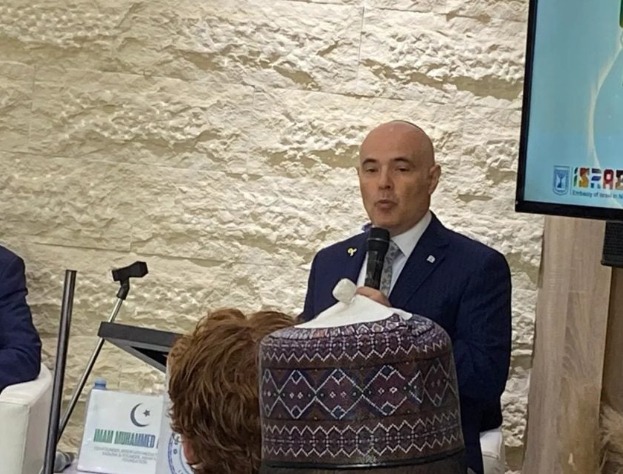
In a report from the Nigerian Tribune on Tuesday, June 9, 2026, Freeman emphasized that Israel’s commitment to peace is fundamentally based on the principles set forth by its founding leaders, especially its first prime minister, David Ben-Gurion.
He noted that this foundational vision still influences the country’s path and is integral to its national identity.
Freeman stated, “This vision continues to be relevant for Israel today, and perhaps that is the most significant lesson from Israel’s history.”
He stressed that the aspiration behind Israel’s creation has always been clear and consistent, adding, “All we have ever wanted was to return to Zion, our ancient homeland, and build a flourishing Jewish and democratic state. To build life, to build a future, and to build hope. And despite every challenge, that is exactly what we have done.”
Looking back at the early years of Israel, the envoy mentioned that the nation started with a modest population of around 650,000 individuals.
He highlighted that it had no oil or significant natural resources and that a large portion of its territory was desert. Nevertheless, he emphasized that the country was determined to create a successful and sustainable nation despite these challenges.
Freeman elaborated, “From the instant we declared our independence, we encountered security threats. However, we did not believe that our geography determined our fate. We figured out how to cultivate crops in the desert, innovated drip irrigation and precision farming, and converted seawater into potable water.”
He stressed that these accomplishments showcase Israel’s resilience and creativity, illustrating how the nation has transformed challenging circumstances into opportunities for development while remaining committed to its lasting vision.